GATE 2026 EE – Question 54
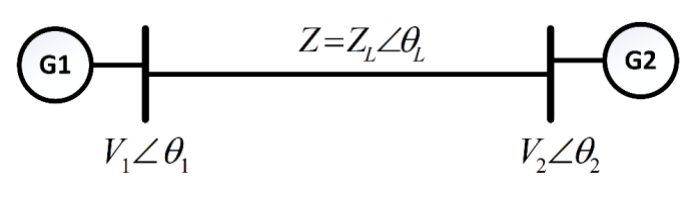
For the balanced 3-phase transmission line shown, consider the following cases:
**Case-1:** $|V_1|=1.1$ p.u., $|V_2|=0.9$ p.u., $Z=0.75\angle0^\circ$ p.u. and $\theta_{12}=\theta_1-\theta_2=0^\circ$
**Case-2:** $|V_1|=1.1$ p.u., $|V_2|=0.9$ p.u., $Z=0.75\angle90^\circ$ p.u. and $\theta_{12}=\theta_1-\theta_2=90^\circ$
Which of the following statements is/are correct about real power loss and reactive power loss in the line?
Practise this question in The GATE Grind →
Show answer and explanation
Correct answer: (A) Real power loss in Case-1 is more than that in Case-2; (D) Reactive power loss in Case-2 is more than that in Case-1
Explanation
The current is $I=(V_1-V_2)/Z$ and the losses are $I^2R$ and $I^2X$. Case-1: $Z=0.75$ is purely resistive. $|V_1-V_2|=0.2$, $|I|=0.267$ and real loss $=0.267^2\times0.75=0.053$ p.u. (reactive loss is 0). Case-2: $Z=j0.75$ is purely reactive, so the real loss is 0. $|V_1-V_2|^2=1.1^2+0.9^2=2.02$, $|I|^2=2.02/0.5625=3.59$ and reactive loss $=3.59\times0.75=2.69$ p.u. So the real loss is larger in Case-1 (A) and the reactive loss is larger in Case-2 (D).