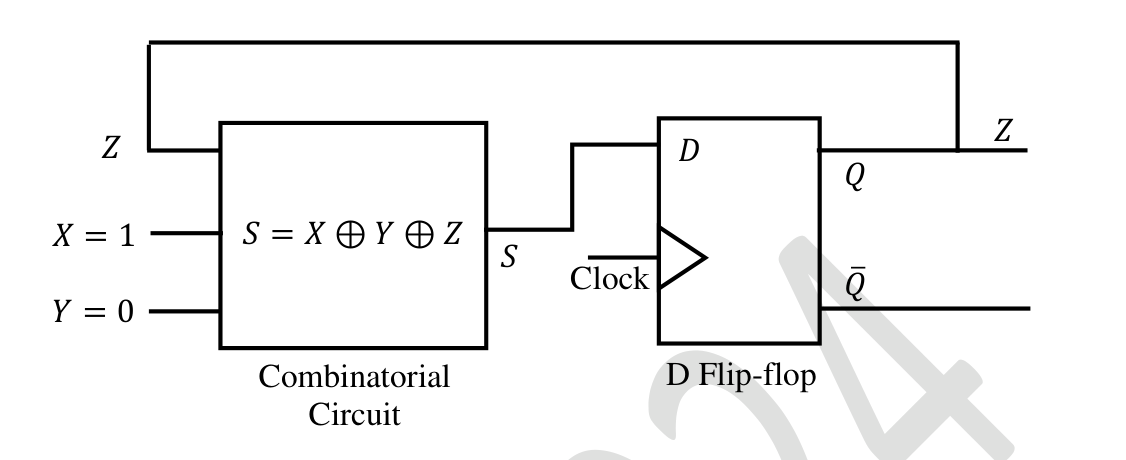
In the circuit, the present value of $Z$ is 1. Neglecting the delay in the combinatorial circuit, the values of $S$ and $Z$, respectively, after the application of the clock will be
(Combinatorial circuit: $S=X\oplus Y\oplus Z$ with $X=1$, $Y=0$; the D flip-flop's $D=S$, its output $Q=Z$ is fed back.)
Before the clock, $Z=1$ so $S=1\oplus0\oplus1=0$. On the clock edge the flip-flop loads $D=S=0$, so $Z$ becomes 0. With no delay in the combinatorial circuit, $S$ immediately updates to $1\oplus0\oplus0=1$. So after the clock $S=1$ and $Z=0$.
More VCOs and timers, combinatorial and sequential logic circuits, multiplexers, demultiplexers questions
GATE 2024 EE Q26– To obtain the Boolean function F(X,Y)=X Y+ X, the inputs PQRS in the figure should be (4:1…
GATE 2023 EE Q56– Neglecting the delays due to the logic gates in the circuit shown in figure, the decimal…
GATE 2023 EE Q57– In a given 8-bit general purpose micro-controller there are following flags. C-Carry,…
GATE 2022 EE Q26– A MOD 2 and a MOD 5 up-counter when cascaded together results in a MOD counter. (in…
GATE 2022 EE Q29– The maximum clock frequency in MHz of a 4-stage ripple counter, utilizing flip-flops, with…
GATE 2021 EE Q32– A 16-bit synchronous binary up-counter is clocked with a frequency f CLK. The two most…