GATE 2021 PH – Question 16
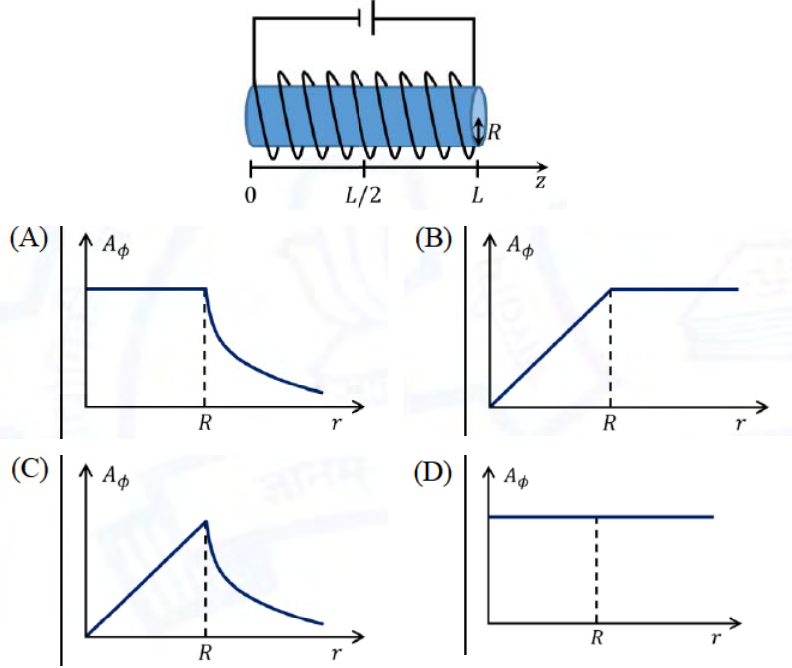
A solenoid of length $L$ and radius $R$, with $R\ll L$, carries a steady current. The magnetic field is uniform inside and zero outside. Choose the variation of the magnitude of the vector potential $(0,A_\phi,0)$ with cylindrical radius $r$ at $z=L/2$. Useful identity: $$\nabla\times\mathbf F=\hat{\mathbf r}\left(\frac1r\frac{\partial F_z}{\partial\phi}-\frac{\partial F_\phi}{\partial z}\right)+\hat{\boldsymbol\phi}\left(\frac{\partial F_r}{\partial z}-\frac{\partial F_z}{\partial r}\right)+\frac{\hat{\mathbf z}}r\left(\frac{\partial(rF_\phi)}{\partial r}-\frac{\partial F_r}{\partial\phi}\right).$$
Practise this question in The GATE Grind →
Show answer and explanation
Correct answer: (C) Figure (C)
Explanation
For azimuthal vector potential, $B_z=r^{-1}d(rA_\phi)/dr$. Inside, integration gives $A_\phi=Br/2$ after excluding the singular $1/r$ term at the axis. Outside, $B_z=0$ implies $A_\phi=C/r$. Continuity at $r=R$ fixes $C=BR^2/2$. Thus $A_\phi$ rises linearly up to $R$ and then decreases as $1/r$, as in C.