GATE 2024 EE – Question 56
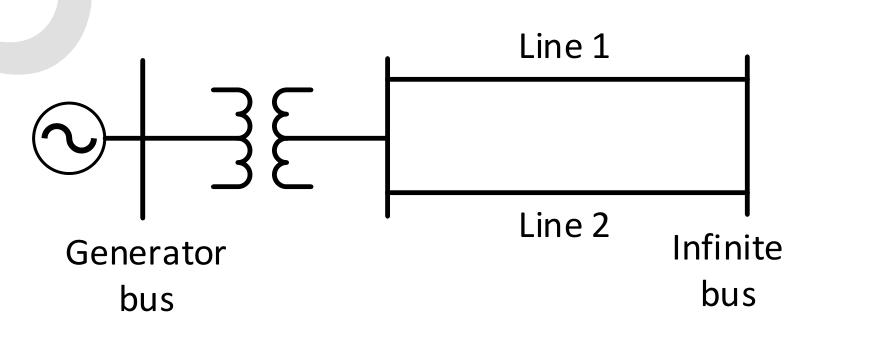
The single line diagram of a lossless system is shown in the figure. The system is operating in steady-state at a stable equilibrium point with the power output of the generator being $P_{max}\sin\delta$, where $\delta$ is the load angle and the mechanical power input is $0.5P_{max}$. A fault occurs on line 2 such that the power output of the generator is less than $0.5P_{max}$ during the fault. After the fault is cleared by opening line 2, the power output of the generator is $\{P_{max}/\sqrt2\}\sin\delta$. If the critical fault clearing angle is $\pi/2$ radians, the accelerating area on the power angle curve is ______ times $P_{max}$ (rounded off to 2 decimal places).
Practise this question in The GATE Grind →
Show answer and explanation
Correct answer: 0.10 to 0.12
Explanation
At the critical clearing angle the accelerating area equals the decelerating area, so compute the decelerating area. The post-fault curve is $\dfrac{P_{max}}{\sqrt2}\sin\delta$ and $P_m=0.5P_{max}$, so the maximum angle satisfies $\sin\delta_{max}=\dfrac{0.5}{0.7071}=0.7071$, i.e. $\delta_{max}=\dfrac{3\pi}4$. With $\delta_c=\dfrac\pi2$: $A_{dec}=\dfrac{P_{max}}{\sqrt2}(\cos\delta_c-\cos\delta_{max})-0.5P_{max}(\delta_{max}-\delta_c)=0.5P_{max}-0.5P_{max}\cdot\dfrac\pi4=0.1073P_{max}$. So the accelerating area is $0.11P_{max}$.