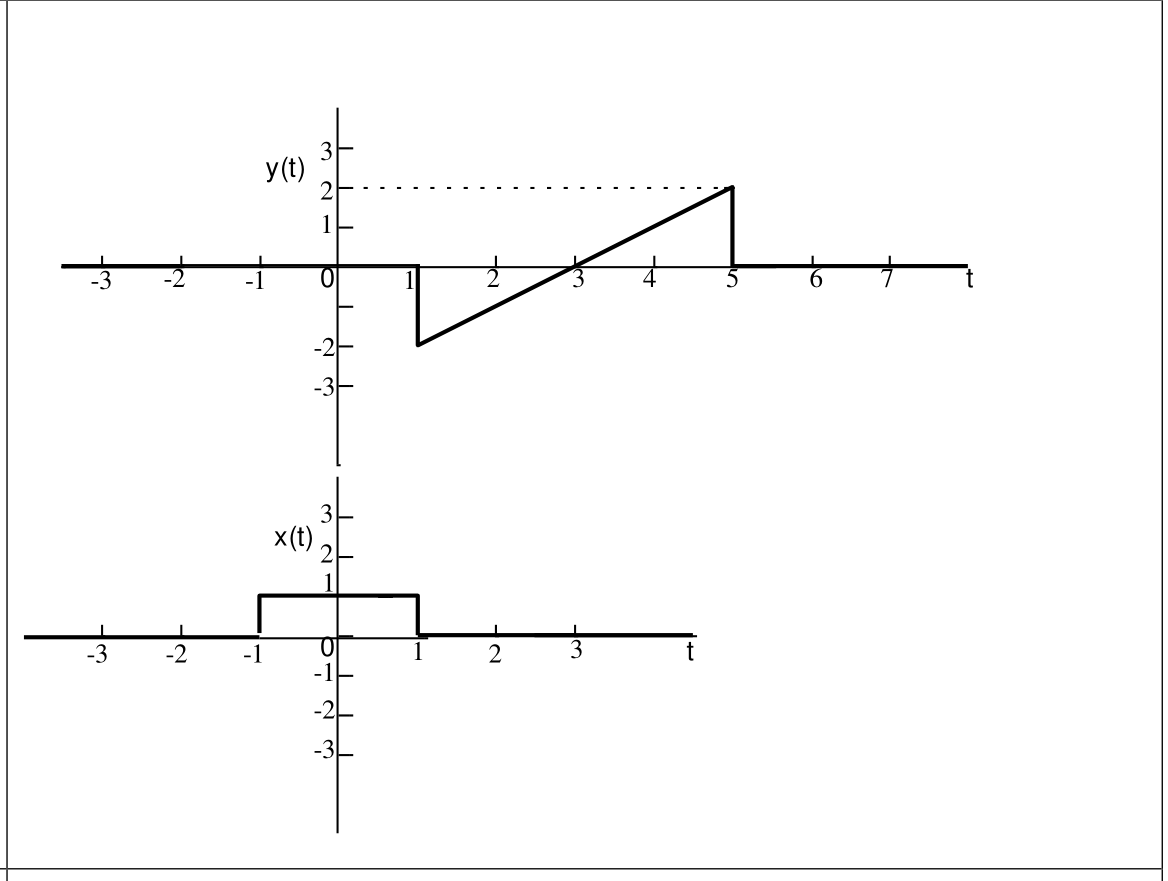
For the signals $x(t)$ and $y(t)$ shown in the figure, $z(t)=x(t)*y(t)$ is maximum at $t=T_1$. Then $T_1$ in seconds is ____________ (Round off to the nearest integer).
$x(t)$ is a unit-height rectangle of width 2 (from $-1$ to $1$), so $z(t)=\int_{t-1}^{t+1}y(u)\,du$ and $\dfrac{dz}{dt}=y(t+1)-y(t-1)$. $y$ is a ramp rising linearly from $-1$ at $t=1$ to $2$ at $t=5$, and zero elsewhere. For $2\le t<4$ both ends lie on the ramp and $y(t+1)-y(t-1)=1.5>0$, so $z$ increases. For $t>4$ the upper end has passed the drop at 5, so $y(t+1)=0$ and $\dfrac{dz}{dt}=-y(t-1)<0$ (the lower end is beyond the zero crossing at 2.33). So $z$ peaks where $t+1=5$, i.e. $t=4$.
More Linear time invariant and causal systems questions
GATE 2023 EE Q36– The magnitude and phase plots of an LTI system are shown in the figure. The transfer…
GATE 2022 EE Q46– Let a causal LTI system be governed by the following differential equation…
GATE 2022 EE Q48– Consider the system as shown below where y(t)=x(et). The system is
GATE 2021 EE Q16– If the input x(t) and output y(t) of a system are related as y(t)=(0,x(t)), then the…
GATE 2021 EE Q17– Two discrete-time linear time-invariant systems with impulse responses h 1[n]=[n-1]+[n+1]…
GATE 2020 EE Q12– Which of the following is true for all possible non-zero choices of integers m,n;\ m n, or…