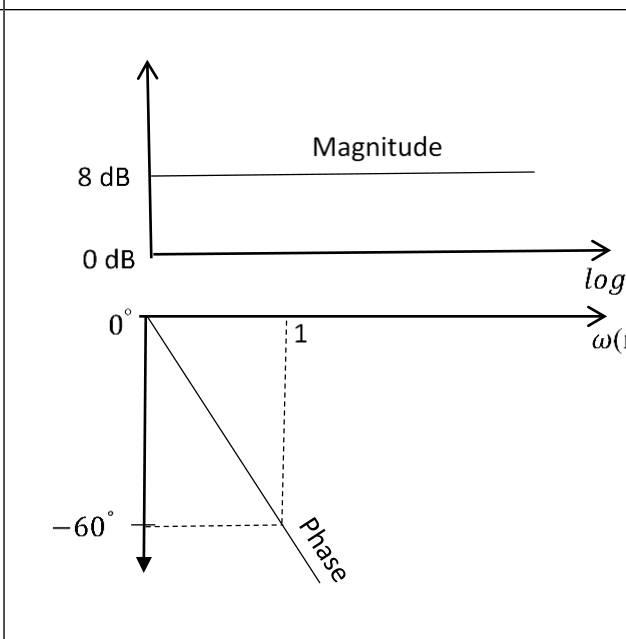
The magnitude is constant at 8 dB, i.e. a gain of $10^{8/20}=2.51$. The phase is a straight line through the origin reaching $-60^\circ=-1.047$ rad at $\omega=1$ rad/s, which is a pure delay $e^{-sT}$ with $T=1.047$ s. So $H(s)=2.51e^{-1.047s}$.
More Linear time invariant and causal systems questions
GATE 2022 EE Q46– Let a causal LTI system be governed by the following differential equation…
GATE 2022 EE Q48– Consider the system as shown below where y(t)=x(et). The system is
GATE 2021 EE Q16– If the input x(t) and output y(t) of a system are related as y(t)=(0,x(t)), then the…
GATE 2021 EE Q17– Two discrete-time linear time-invariant systems with impulse responses h 1[n]=[n-1]+[n+1]…
GATE 2020 EE Q12– Which of the following is true for all possible non-zero choices of integers m,n;\ m n, or…
GATE 2020 EE Q47– Suppose for input x(t) a linear time-invariant system with impulse response h(t) produces…