GATE 2011 CS (CS1) – Question 63
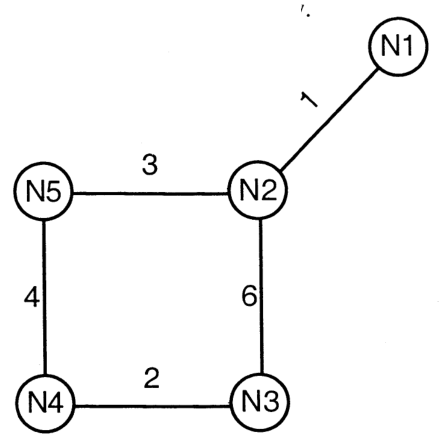
A symmetric five-node distance-vector network has links N1–N2=1,N2–N5=3,N5–N4=4,N4–N3=2,N2–N3=6. Stable vectors in N1,…,N5 order are N1:(0,1,7,8,4), N2:(1,0,6,7,3), N3:(7,6,0,2,6), N4:(8,7,2,0,4), N5:(4,3,6,4,0). Each round exchanges current vectors, then updates; link-cost changes immediately affect only the incident nodes’ corresponding entries. First perform the N2–N3 decrease and update round from the previous question, so N3 has (3,2,0,2,5). Now N1–N2 fails and N2 immediately marks its N1 distance infinite. After the NEXT update round, what is N3’s distance to N1?
Practise this question in The GATE Grind →
Show answer and explanation
Correct answer: (C) 10
Explanation
N3 receives N2’s infinite N1 distance. Its other neighbour N4 still advertises the previous-round N1 estimate eight, computed before it learns the failure. N3 therefore chooses 2+8=10 through N4, C. Synchronous distance-vector updates can temporarily route using stale information and count toward infinity.
More Routing: Distance Vector and Link State Routing questions
- GATE 2010 CS (CS1) Q64
- GATE 2010 CS (CS1) Q65
- GATE 2021 CS (CS2) Q55
- GATE 2025 CS (CS1) Q40
- GATE 2025 CS (CS2) Q17
- GATE 2023 CS Q25
All Routing: Distance Vector and Link State Routing questions →