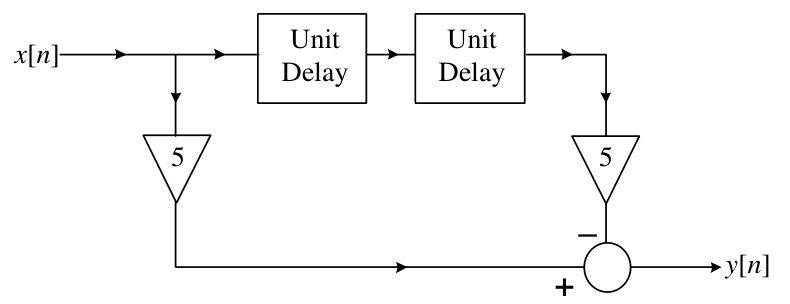
The diagram subtracts the two-sample delayed branch from the direct branch: $y[n]=5x[n]-5x[n-2]$. Hence $H(e^{j\omega})=5(1-e^{-j2\omega})=10je^{-j\omega}\sin\omega$.
Its magnitude is $10|\sin\omega|$, zero at DC and at π, and maximal at π/2. It passes middle frequencies and rejects both extremes. Thus it approximates a **band-pass filter, C**.
More Discrete-time Signals questions
GATE 2025 EC Q27– Let x[n] be a discrete-time signal whose z-transform is X(z). Which of the following…
GATE 2024 EC Q56– The radian frequency value(s) for which the discrete time sinusoidal signal x[n]=A( n+/3)…
GATE 2024 EC Q59– The relationship between any N-length sequence x[n] and its corresponding N-point discrete…
GATE 2023 EC Q47– Consider a discrete-time periodic signal with period N=5. Let the discrete-time Fourier…
GATE 2023 EC Q48– Let an input x[n] having discrete time Fourier transform X(ej)=1-e-j+2e-3j be passed…
GATE 2022 EC Q55– For a vector x=[x[0],x[1],,x[7]], the 8-point discrete Fourier transform (DFT) is denoted…