GATE 2021 EC – Question 38
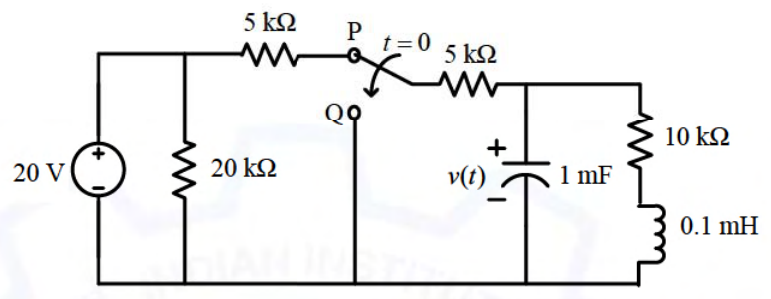
The switch in the circuit in the figure is in position P for a long time and then moved to position Q at time $t=0$.
The value of $\frac{dv(t)}{dt}$ at $t=0^+$ is
Practise this question in The GATE Grind →
Show answer and explanation
Correct answer: (C) $-3$ V/s
Explanation
With the switch at P for a long time the circuit is in DC steady state: the capacitor is open and the inductor a short, so the current is $\frac{20}{5\text{k}+5\text{k}+10\text{k}}=1$ mA. This flows through the $10\ \text{k}\Omega$ and the inductor, so $v(0^-)=1\text{ mA}\times10\text{ k}\Omega=10$ V and $i_L(0^-)=1$ mA. At $t=0^+$ both are unchanged, and the switch connects the $5\ \text{k}\Omega$ to ground. KCL at the capacitor node: $C\frac{dv}{dt}=-\frac{10}{5\text{k}}-i_L=-2\text{ mA}-1\text{ mA}=-3$ mA, so $\frac{dv}{dt}=\frac{-3\text{ mA}}{1\text{ mF}}=-3$ V/s.