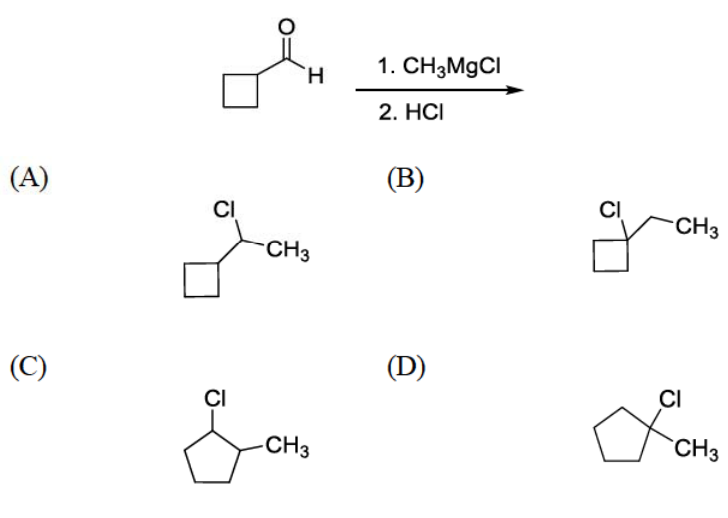
Grignard addition first gives a secondary cyclobutylcarbinol after protonation. Under acid, loss of water generates a cyclobutylcarbinyl cation, which rearranges by ring expansion to relieve four-membered-ring strain. A subsequent hydride shift gives the more stable tertiary cyclopentyl cation, captured by chloride. The resulting 1-chloro-1-methylcyclopentane is D.
More Types of Reactions: Nucleophilic and electrophilic substitution reactions (both aromatic and aliphatic). Addition reactions to carbon-carbon and carbon-heteroatom (N and O) multiple bonds. Elimination reactions. Reactive intermediates – carbocation, carbanion, carbenes, nitrenes, arynes and free radicals. Molecular rearrangements. Barton decarboxylation and Barton-McCombie reaction, Hunsdiecker reaction. questions
GATE 2024 CY Q24– The reaction(s) that yield(s) X as the major product is (are)
GATE 2025 CY Q26– Among the given options, the possible product(s) that can be obtained from the following…
GATE 2025 CY Q54– The process(es) and/or intermediate(s) through which the following transformation proceeds…
GATE 2026 CY Q11– The major product formed in the following reaction is
GATE 2026 CY Q36– The major product formed in the following reaction is
GATE 2023 CY Q14– The major product formed in the given reaction is