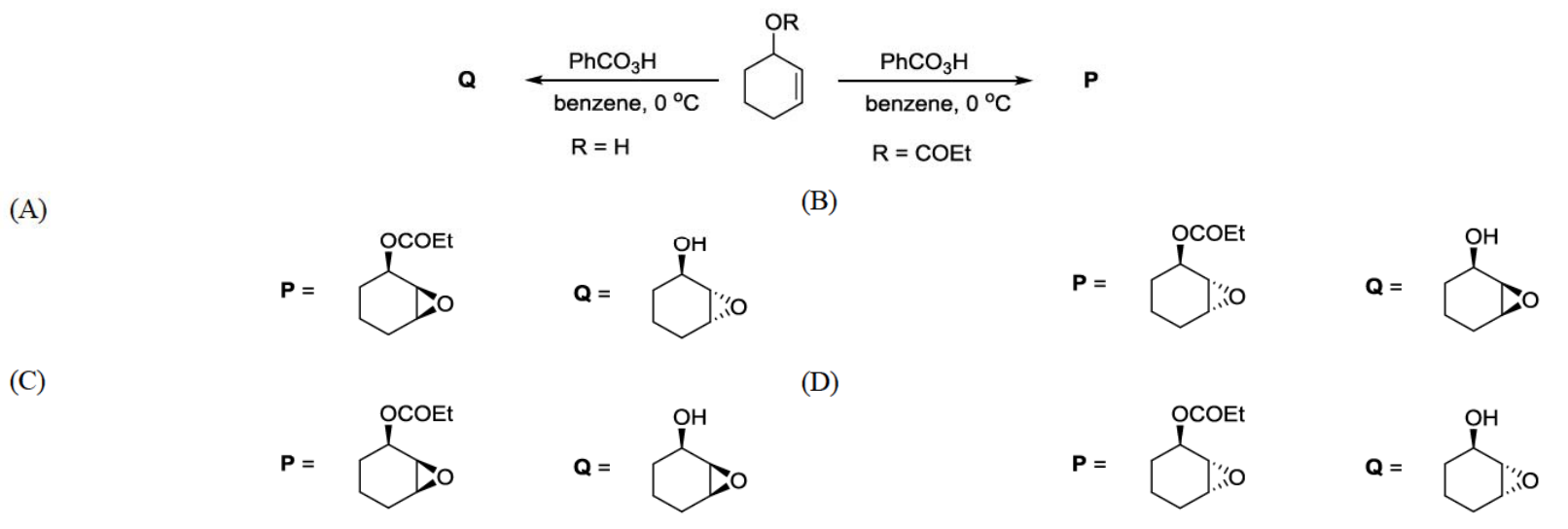
Perbenzoic acid in benzene at 0°C epoxidizes the illustrated allylic derivatives. P is obtained for R=COEt and Q for R=H. Which product pair is correct?
With a free allylic OH, hydrogen bonding to the peracid directs oxygen delivery from the OH face, giving the syn epoxide Q. Acyl protection removes that directing OH interaction; approach from the less hindered opposite face gives anti epoxide P for the propionate. The pair with P anti and Q syn is B.
More Oxidation: Oxidation of alcohols involving metal and non-metal-based (chromium, manganese, DMSO, and hypervalent iodine) reagents. Peracid oxidation of alkenes and carbonyls. Alkenes to diols (manganese and osmium-based reagents), alkenes to carbonyls with bond cleavage (ozonolysis), and alkenes to alcohols/carbonyls without bond cleavage (hydroboration-oxidation). Asymmetric epoxidations (Sharpless and Jacobsen) and Sharpless asymmetric hydroxylation. questions
GATE 2025 CY Q25– The correct option(s) of reagents and reaction sequences suitable for carrying out the…
GATE 2025 CY Q55– For the following reaction, the possible product(s) is/are
GATE 2026 CY Q22– The reaction(s) that give(s) meso-1,2-diphenylethane-1,2-diol as the major product is(are)