GATE 2025 CS (CS1) – Question 9
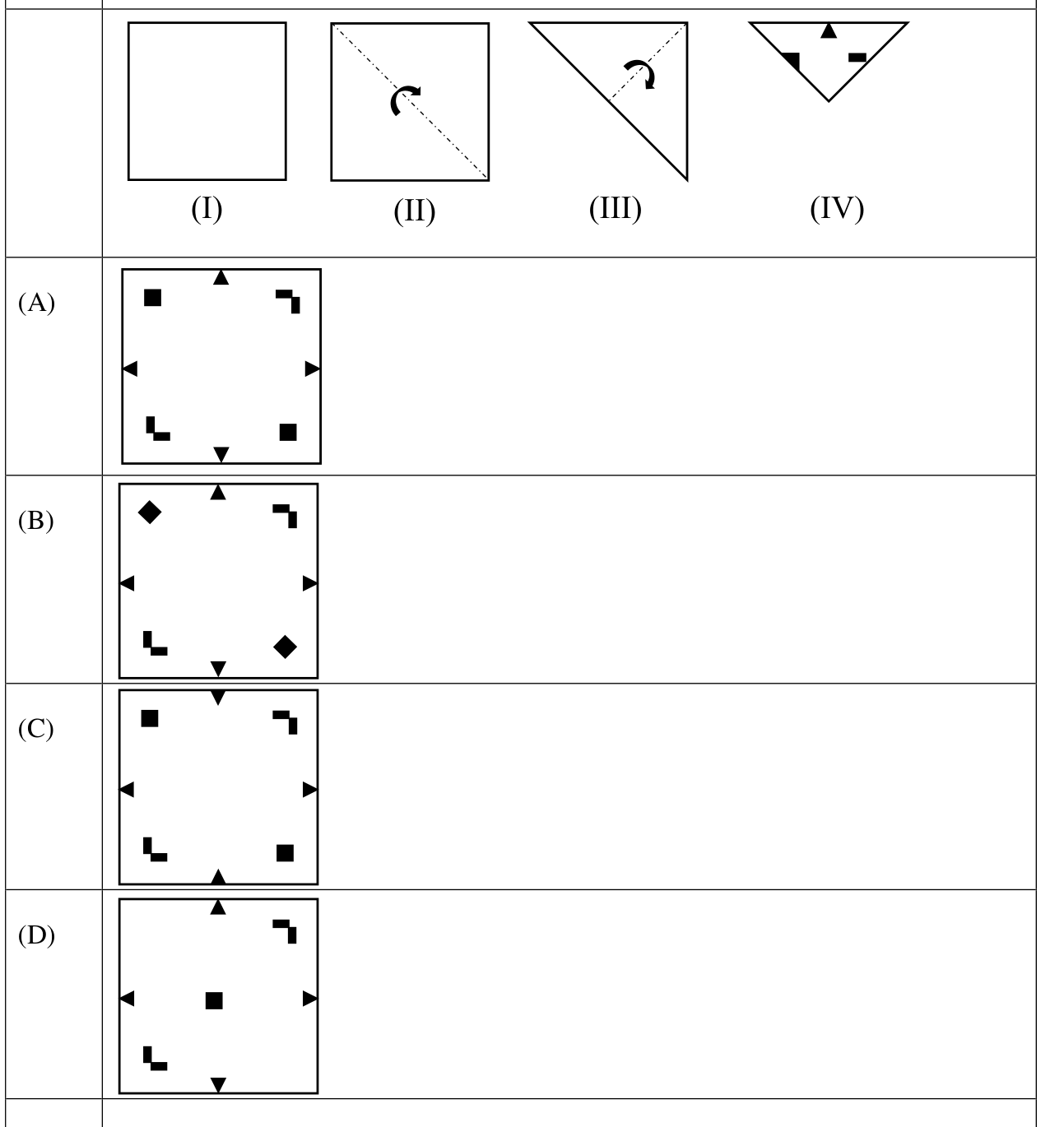
A square paper, shown in figure (I), is folded along the dotted lines as shown in the figures (II) and (III). Then a few cuts are made as shown in figure (IV). Which one of the following patterns will be obtained when the paper is unfolded?
Note: The figures shown are representative.
[Figures: (I) plain square. (II) square folded along a diagonal. (III) resulting triangle folded again. (IV) small triangle with three cuts: a triangle near the top edge, a square-like cut on the left and a small dash on the right.]
Practise this question in The GATE Grind →
Show answer and explanation
Correct answer: (A) Square cuts at top-left and bottom-right, L-shaped cuts at top-right and bottom-left, and triangle cuts at the midpoints of all four edges
Explanation
Unfold in reverse order, reflecting every cut first across the last fold and then across the first diagonal fold. The edge triangle therefore repeats at the four edge midpoints, and the other two cuts repeat in opposite pairs.
The square-shaped cut retains sides parallel to the paper edges under these diagonal reflections, producing two opposite squares, not diamonds. The remaining stepped cut produces the two opposite L-shapes. A matches these locations and orientations.
B has diamonds instead of the required squares, C reverses the top/bottom edge-triangle orientation, and D puts a square at the centre instead of the opposite pair. Therefore **A**. Symmetry alone is not sufficient, since an incorrect cut shape can also be symmetrically repeated.