GATE 2022 EE – Question 53
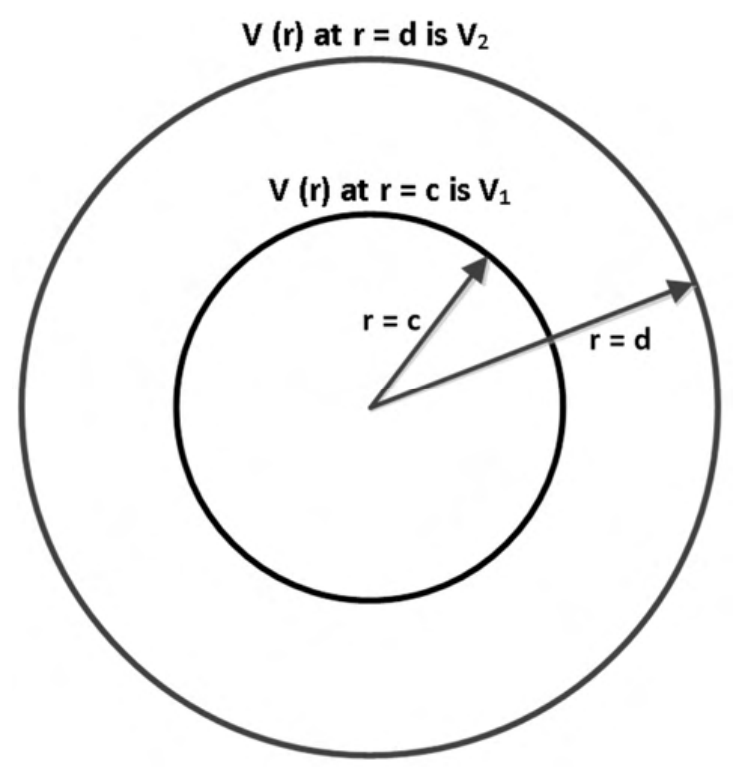
As shown in the figure below, two concentric conducting spherical shells, centered at $r=0$ and having radii $r=c$ and $r=d$ are maintained at potentials such that the potential $V(r)$ at $r=c$ is $V_1$ and $V(r)$ at $r=d$ is $V_2$. Assume that $V(r)$ depends only on $r$, where $r$ is the radial distance. The expression for $V(r)$ in the region between $r=c$ and $r=d$ is
Practise this question in The GATE Grind →
Show answer and explanation
Correct answer: (B) $V(r)=\dfrac{cd(V_1-V_2)}{(d-c)r}+\dfrac{V_2d-V_1c}{d-c}$
Explanation
Laplace's equation with spherical symmetry gives $V(r)=\frac Ar+B$. The conditions $V(c)=V_1$ and $V(d)=V_2$ give $A=\frac{cd(V_1-V_2)}{d-c}$ and $B=\frac{V_2d-V_1c}{d-c}$, which is option B.