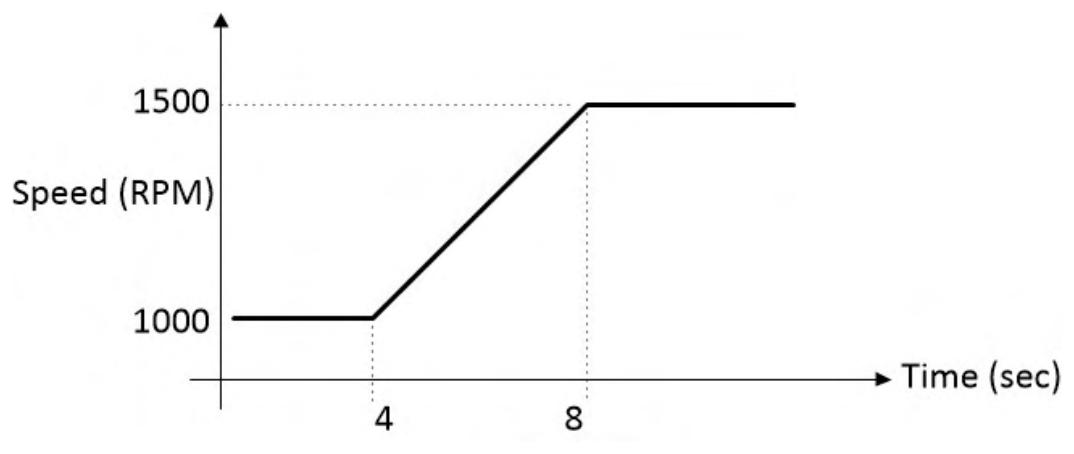
A 4-pole induction motor with inertia of 0.1 kg-m$^2$ drives a constant load torque of 2 Nm. The speed of the motor is increased linearly from 1000 rpm to 1500 rpm in 4 seconds as shown in the figure below. Neglect losses in the motor. The energy, in joules, consumed by the motor during the speed change is ________. (round off to nearest integer)
The speeds are $\omega_1=104.72$ and $\omega_2=157.08$ rad/s. The gain in kinetic energy is $\frac12J(\omega_2^2-\omega_1^2)=0.05\times(24674-10966)=685$ J. The load energy over the 4 s is $T_L\times\omega_{avg}\times t=2\times130.9\times4=1047$ J. The total energy is $685+1047=1733$ J.
More Three-phase induction machines: principle of operation, types, performance, torque-speed characteristics, no-load and blocked-rotor tests, equivalent circuit, starting and speed control questions
GATE 2022 EE Q65– A 3-phase, 415 V, 4-pole, 50 Hz induction motor draws 5 times the rated current at rated…
GATE 2021 EE Q28– The power input to a 500 V, 50 Hz, 6-pole, 3-phase induction motor running at 975 RPM is…
GATE 2021 EE Q55– An 8-pole, 50 Hz, three-phase, slip-ring induction motor has an effective rotor resistance…
GATE 2020 EE Q27– A three-phase, 50 Hz, 4-pole induction motor runs at no-load with a slip of 1 %. With full…
GATE 2019 EE Q20– The parameter of an equivalent circuit of a three-phase induction motor affected by…
GATE 2019 EE Q57– A delta-connected, 3.7 kW, 400 V(line), three-phase, 4-pole, 50-Hz squirrel-cage induction…