GATE 2026 XE — all source sections – Question 111
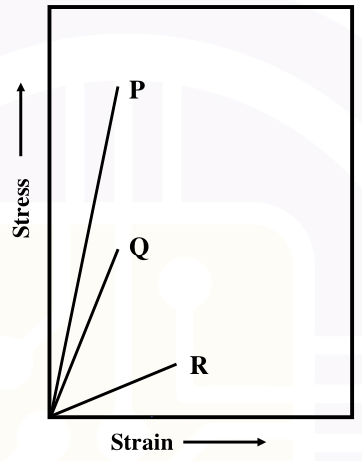
The graph shows longitudinal tensile stress–strain profiles P, Q, R for a brittle polymer, glass fibre and their unidirectional continuous-fibre composite. Assume no matrix voids, perfect fibre–matrix bonding and no residual stress. Identify the profiles.
Practise this question in The GATE Grind →
Show answer and explanation
Correct answer: (B) P glass fibre; Q composite; R matrix
Explanation
The initial slope is Young’s modulus. Glass fibre has the largest stiffness, P, and the polymer matrix the lowest, R. Under longitudinal iso-strain loading with ideal bonding, the composite modulus follows the rule of mixtures and lies between the two, Q. Therefore B. The comparison concerns longitudinal continuous-fibre loading, not the transverse modulus.