GATE 2019 EC – Question 43
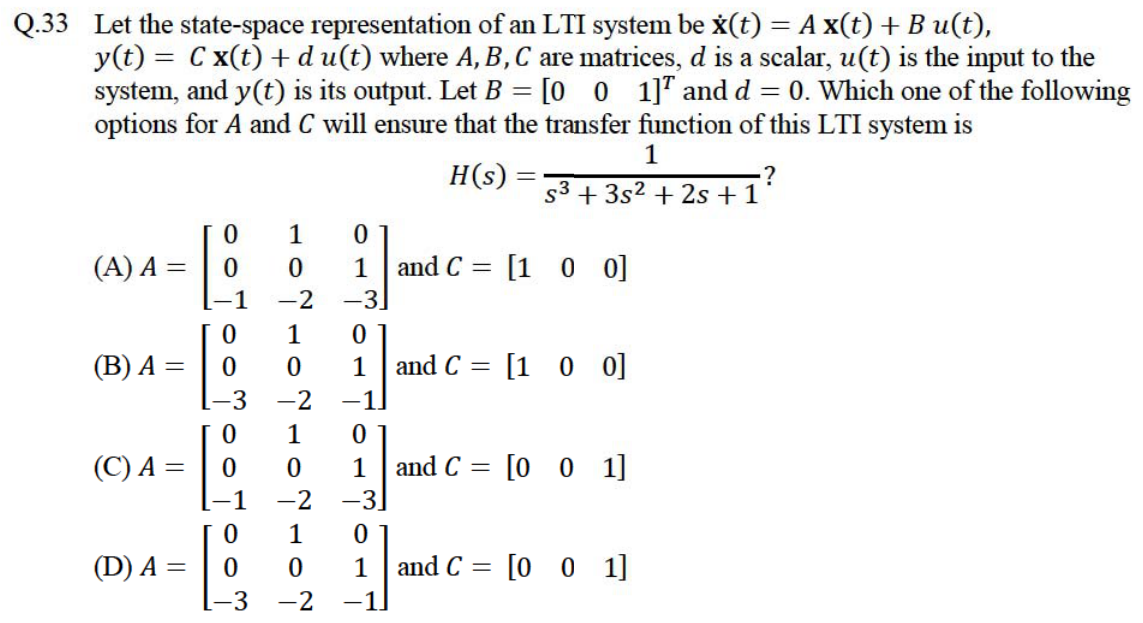
Let the state-space representation of an LTI system be $\dot x(t)=Ax(t)+Bu(t)$, $y(t)=Cx(t)+du(t)$ where $A,B,C$ are matrices, $d$ is a scalar, $u(t)$ is the input to the system, and $y(t)$ is its output. Let $B=[0\ 0\ 1]^T$ and $d=0$. Which one of the following options for $A$ and $C$ will ensure that the transfer function of this LTI system is
$$H(s)=\frac{1}{s^3+3s^2+2s+1}?$$
Practise this question in The GATE Grind →
Show answer and explanation
Correct answer: (A) $A=\begin{bmatrix}0&1&0\\0&0&1\\-1&-2&-3\end{bmatrix}$ and $C=[1\ 0\ 0]$
Explanation
This is the controllable canonical form: the last row of $A$ holds the negated denominator coefficients $[-1,-2,-3]$ (for $s^3+3s^2+2s+1$), and with $B=[0\ 0\ 1]^T$ the output $y=x_1$ (so $C=[1\ 0\ 0]$) gives the numerator 1.