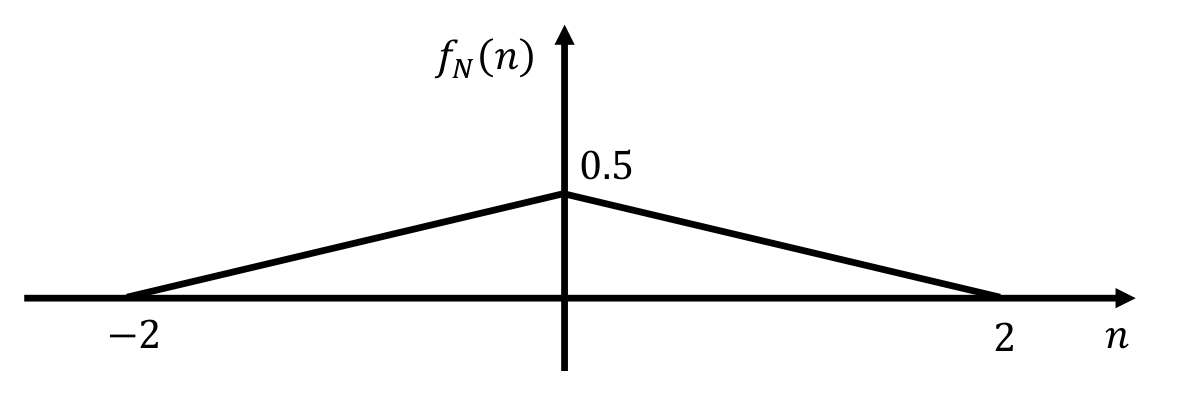
A binary source generates symbols $X\in\{-1,1\}$ which are transmitted over a noisy channel. The probability of transmitting $X=1$ is 0.5. Input to the threshold detector is $R=X+N$. The probability density function $f_N(n)$ of the noise $N$ is shown below.
If the detection threshold is zero, then the probability of error (correct to two decimal places) is ________.
The noise pdf is a triangle on $[-2,2]$ with peak 0.5, so $f_N(n)=0.5\left(1-\frac{|n|}{2}\right)$. An error for $X=1$ needs $N<-1$, and for $X=-1$ needs $N>1$, each with probability $\int_1^2 0.5\left(1-\frac n2\right)dn=0.125$. So $P_e=0.125\approx0.13$.
More Digital Communications questions
GATE 2018 EC Q50– A random variable X takes values -0.5 and 0.5 with probabilities 14 and 34, respectively.…
GATE 2016 EC Q31– Consider binary data transmission at a rate of 56 kbps using baseband binary pulse…
GATE 2016 EC Q59– A digital communication system uses a repetition code for channel encoding/decoding.…
GATE 2016 EC Q60– An analog pulse s(t) is transmitted over an additive white Gaussian noise (AWGN) channel.…
GATE 2015 EC Q60– The transmitted signal in a GSM system is of 200 kHz bandwidth and 8 users share a common…
GATE 2015 EC Q62– A source emits bit 0 with probability 13 and bit 1 with probability 23. The emitted bits…