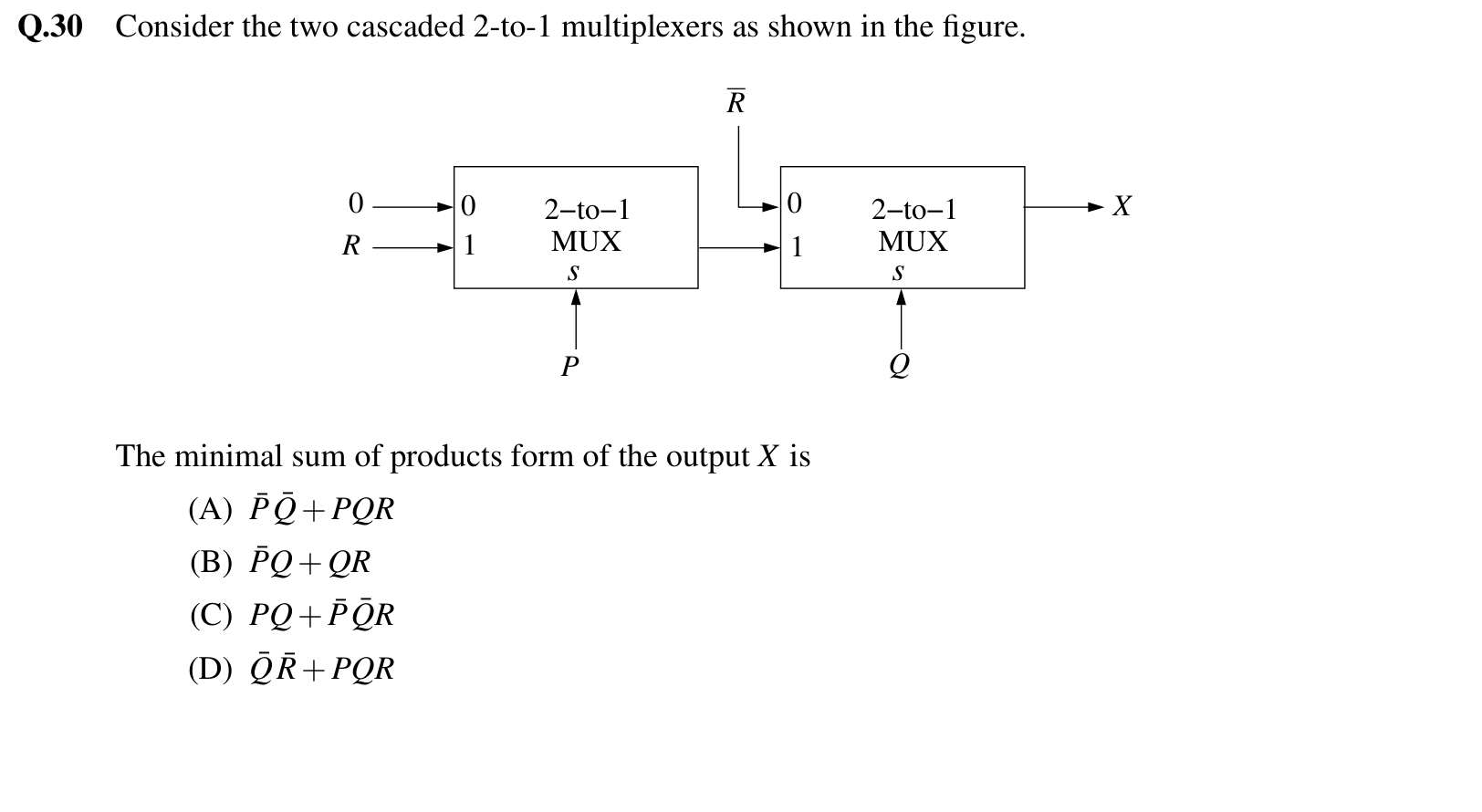
The first multiplexer outputs $\bar{P} \cdot 0 + P \cdot R = PR$. The second multiplexer selects $\bar{R}$ when $Q = 0$ and $PR$ when $Q = 1$, so $X = \bar{Q}\bar{R} + Q \cdot PR = \bar{Q}\bar{R} + PQR$.
More Combinational Circuits questions
GATE 2014 CS (CS1) Q55– For the 4-to-1 multiplexer shown, with select lines S 1 and S 0, find the minimal…
GATE 2014 CS (CS3) Q18– A combinational block has Boolean inputs x,a,b and output y: f(x,y,a,b) if (x is 1) y = a;…
GATE 2012 CS Q29– How much ROM implements a four-bit multiplier?
GATE 2013 CS Q15– Inputs D₀,D₁,D₂,D₃ and outputs X₀,X₁,V have rows: 0000→xx0; 1000→001; x100→011; xx10→101;…
GATE 2013 CS Q56– A RAM chip stores 1024 eight-bit words. How many 2-to-4 decoders with enable are needed to…
GATE 2010 CS Q19– The shown 4:1 multiplexer has select inputs P (MSB),Q (LSB). What is f?