GATE 2016 EE – Question 44
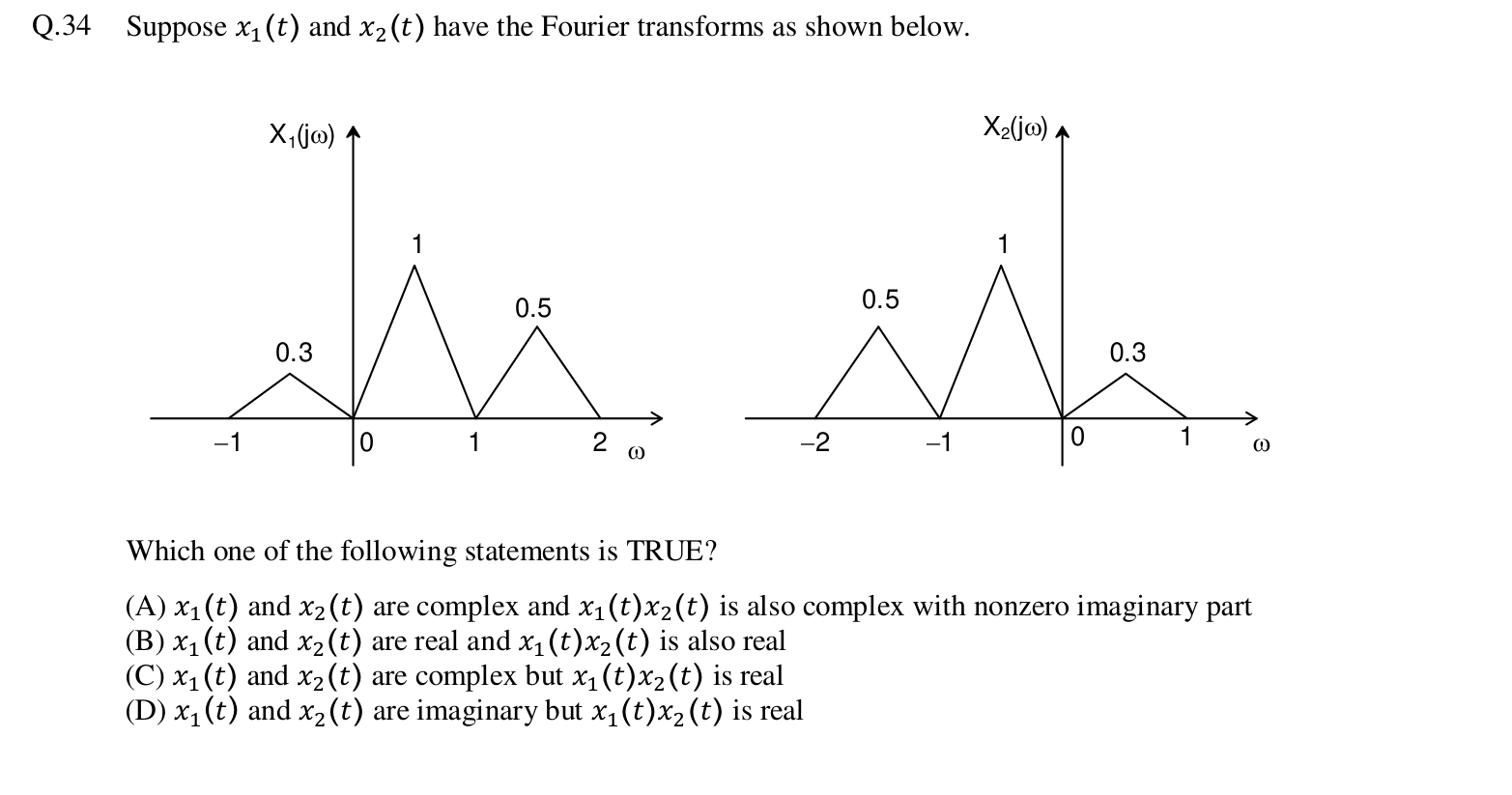
Suppose $x_1(t)$ and $x_2(t)$ have the Fourier transforms as shown below.
[Figure: $X_1(j\omega)$ is real and made of three triangles: height 0.3 over $\omega$ from $-1$ to 0, height 1 over 0 to 1, and height 0.5 over 1 to 2. $X_2(j\omega)$ is its mirror image: height 0.5 over $-2$ to $-1$, height 1 over $-1$ to 0, and height 0.3 over 0 to 1.]
Which one of the following statements is TRUE?
Practise this question in The GATE Grind →
Show answer and explanation
Correct answer: (C) $x_1(t)$ and $x_2(t)$ are complex but $x_1(t)x_2(t)$ is real
Explanation
A real signal needs $X(-\omega) = X^*(\omega)$. Here $X_1$ is real but not even, so $X_1(-\omega) \neq X_1^*(\omega)$, and $x_1(t)$ is complex. The transform of the conjugate signal $x_1^*(t)$ is $X_1^*(-\omega) = X_1(-\omega)$, which is exactly the mirror image $X_2(\omega)$. So $x_2(t) = x_1^*(t)$, and the product $x_1(t)x_2(t) = |x_1(t)|^2$ is real.