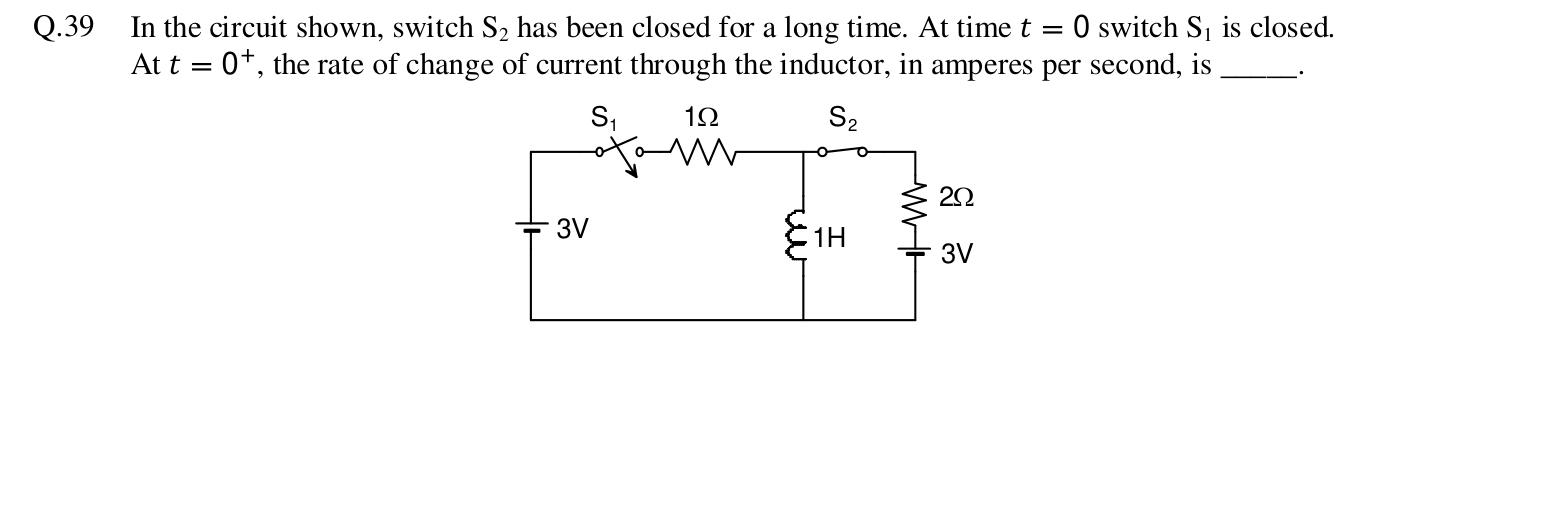
In the circuit shown, switch $S_2$ has been closed for a long time. At time $t = 0$ switch $S_1$ is closed. At $t = 0^+$, the rate of change of current through the inductor, in amperes per second, is ________.
Before $S_1$ closes the inductor is steady, acting as a short, so it carries $\frac{3}{2} = 1.5$ A from the right-hand 3 V source through the 2 Ω resistor. The inductor current cannot change suddenly, so at $t = 0^+$ it is still 1.5 A. With the node voltage $v$, KCL gives $\frac{3 - v}{1} + \frac{3 - v}{2} = 1.5$, so $(3 - v)(1.5) = 1.5$ and $v = 2$ V. The inductor voltage is 2 V, so $\frac{di}{dt} = \frac{v}{L} = \frac{2}{1} = 2$ A/s.
More Transient response of DC and AC networks, sinusoidal steady-state analysis, resonance, two port networks, balanced three phase circuits, star-delta transformation, complex power and power factor in AC circuits questions
GATE 2016 EE Q62– In the circuit shown below, the supply voltage is 10(1000t) volts. The peak value of the…
GATE 2016 EE Q64– The circuit below is excited by a sinusoidal source. The value of R, in , for which the…
GATE 2015 EE Q30– An inductor is connected in parallel with a capacitor as shown in the figure. As the…
GATE 2015 EE Q55– The circuit shown in the figure has two sources connected in series. The instantaneous…
GATE 2015 EE Q56– In a linear two-port network, when 10 V is applied to Port 1, a current of 4 A flows…
GATE 2017 EE Q19– A source is supplying a load through a 2-phase, 3-wire transmission system as shown in…