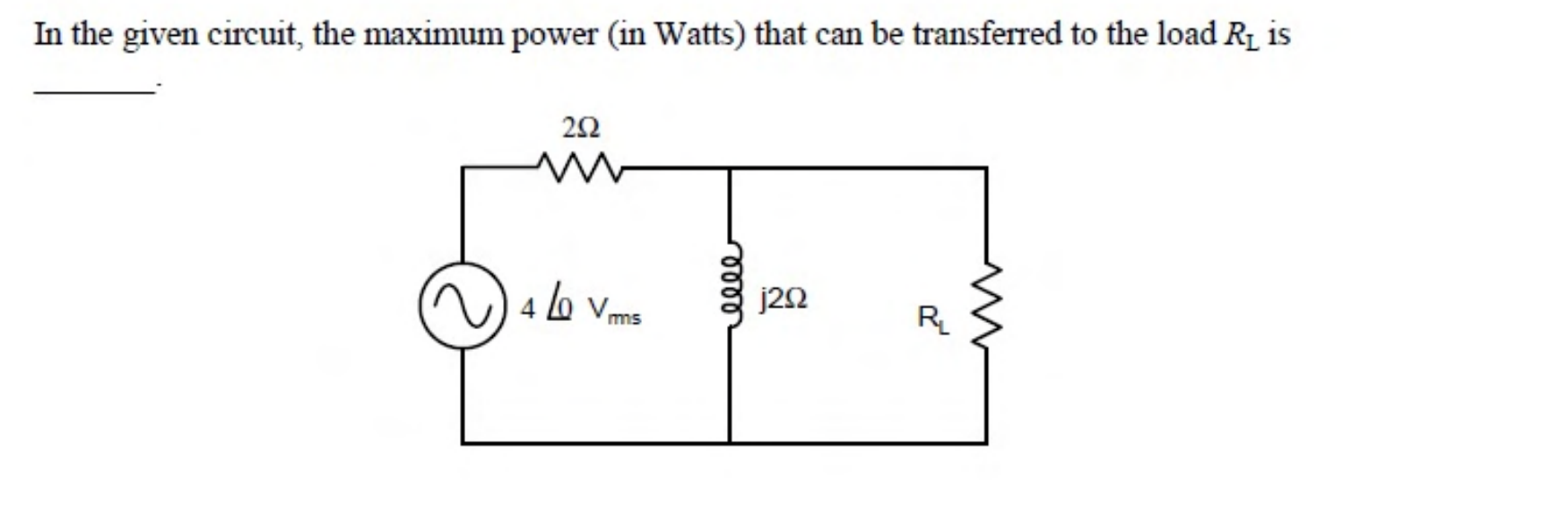
The load is purely resistive, so the maximum power goes to $R_L = |Z_{th}|$. The Thevenin impedance seen by the load is $2 \parallel j2 = 1 + j$, with magnitude $\sqrt{2}$. The Thevenin voltage magnitude is $4 \times \frac{|j2|}{|2 + j2|} = 2\sqrt{2}$ V. The power is $\frac{|V_{th}|^2 R_L}{|Z_{th} + R_L|^2} = \frac{8 \times 1.414}{(1 + 1.414)^2 + 1} = \frac{11.31}{6.83} = 1.66$ W.
More Sinusoidal Steady State Analysis questions
GATE 2017 EC Q17– In the circuit shown, the positive angular frequency (in radians per second) at which the…
GATE 2017 EC Q44– The figure shows an RLC circuit excited by the sinusoidal voltage 100(3t) Volts, where t…
GATE 2014 EC (EC1) Q16– For maximum power transfer between cascaded network sections, how should the first…
GATE 2014 EC (EC1) Q41– A 230 V rms source feeds two parallel loads: 10 kW at 0.8 leading power factor, and 10 kVA…
GATE 2014 EC (EC2) Q40– A series LCR circuit operates off resonance with current leading supply voltage. Current…