GATE 2015 EC – Question 55
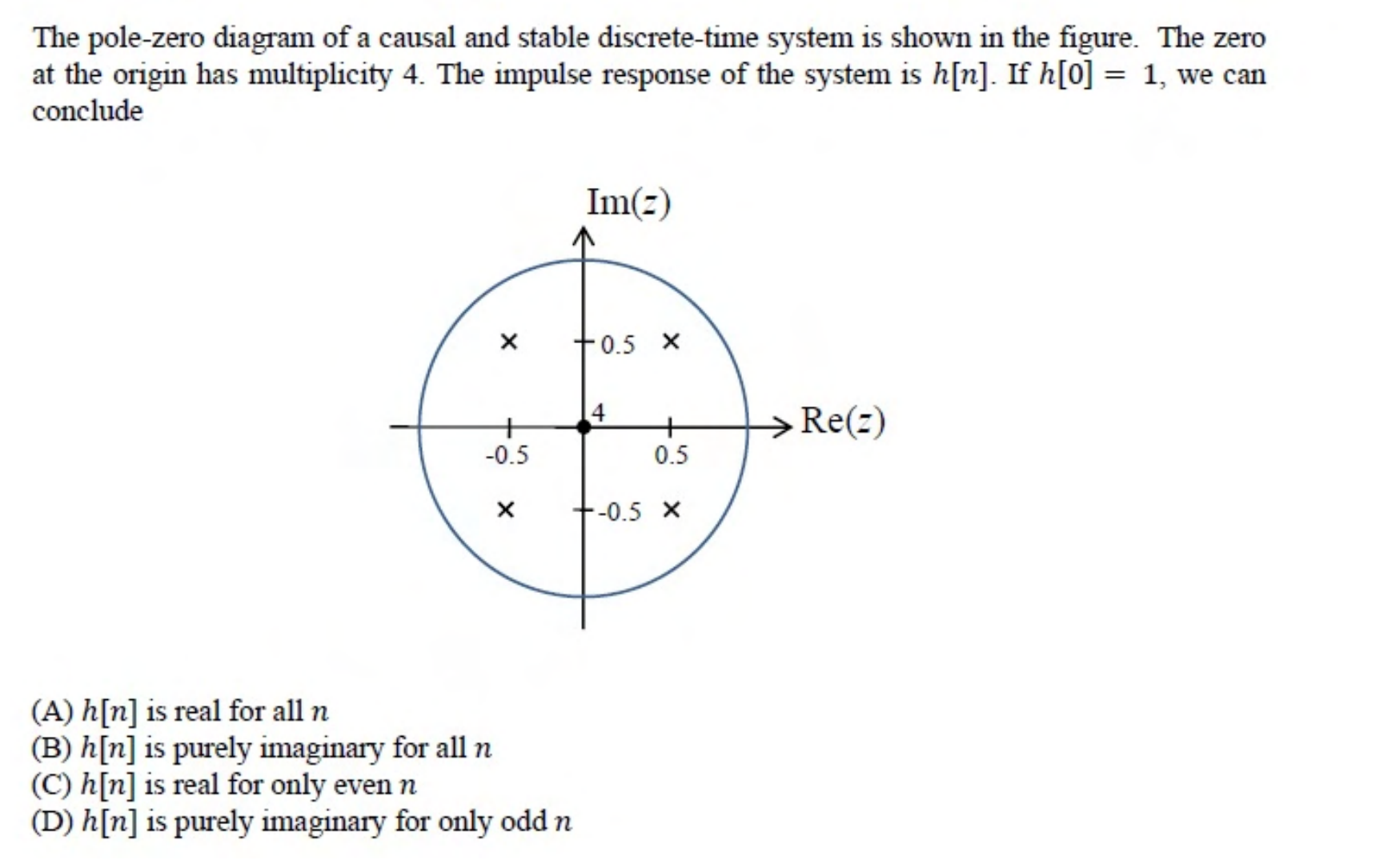
The pole-zero diagram of a causal and stable discrete-time system is shown in the figure. The zero at the origin has multiplicity 4. The impulse response of the system is $h[n]$. If $h[0] = 1$, we can conclude
Practise this question in The GATE Grind →
Show answer and explanation
Correct answer: (A) $h[n]$ is real for all $n$
Explanation
The poles come in complex conjugate pairs, so the transfer function has real coefficients. A causal system with real coefficients and $h[0] = 1$ has a real impulse response for all $n$.