GATE 2015 EE – Question 23
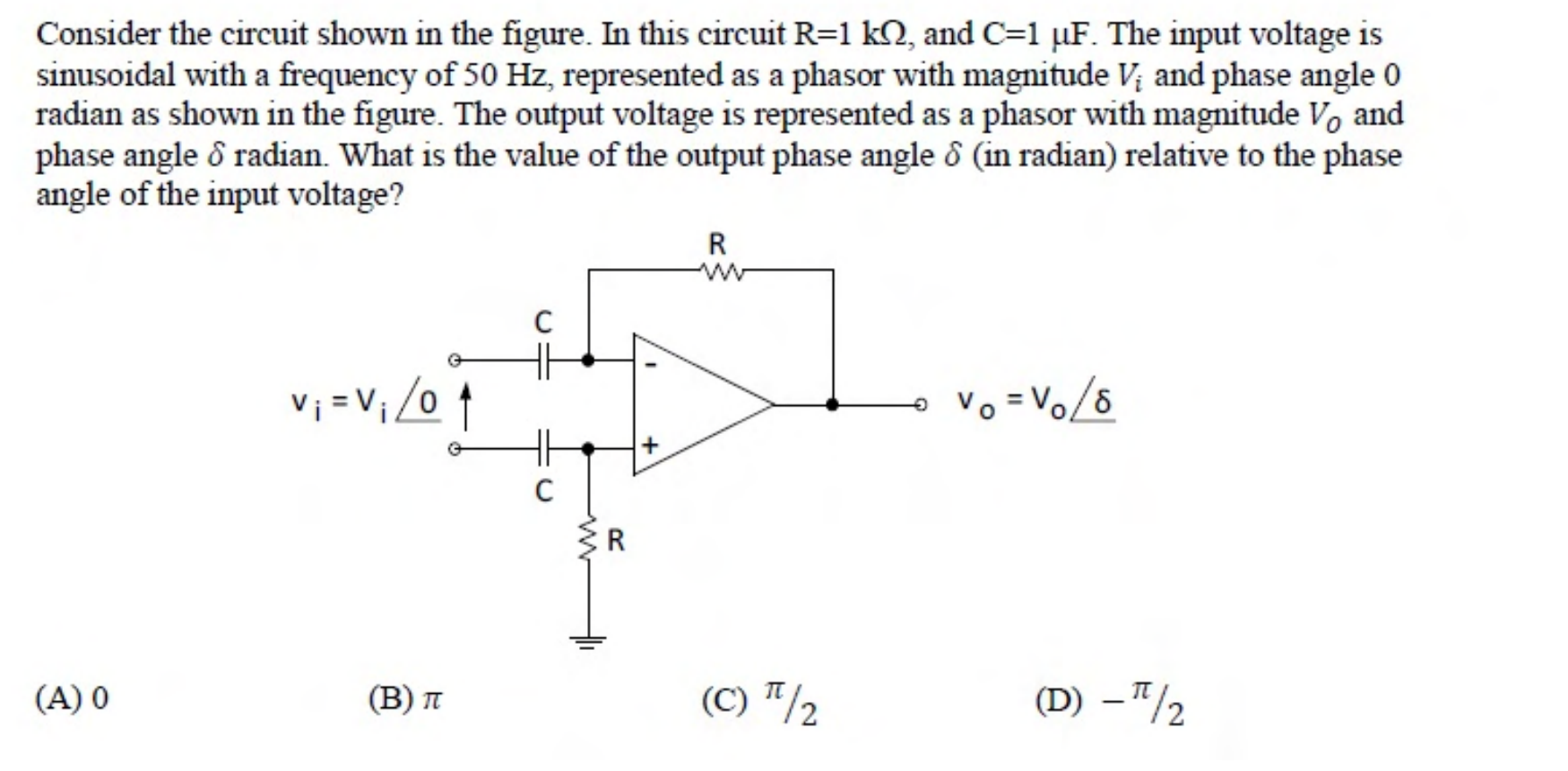
Consider the circuit shown in the figure. In this circuit $R = 1\ \text{k}\Omega$, and $C = 1\ \mu\text{F}$. The input voltage is sinusoidal with a frequency of 50 Hz, represented as a phasor with magnitude $V_i$ and phase angle 0 radian as shown in the figure. The output voltage is represented as a phasor with magnitude $V_o$ and phase angle $\delta$ radian. What is the value of the output phase angle $\delta$ (in radian) relative to the phase angle of the input voltage?
Practise this question in The GATE Grind →
Show answer and explanation
Correct answer: (D) $-\frac{\pi}{2}$
Explanation
Let $x = j\omega RC$. If the lower input terminal is at $v_b$, the upper terminal is at $v_b + v_i$. The non-inverting input is $V_+ = v_b\frac{x}{1 + x}$. The output is $V_o = (1 + x)V_+ - x(v_b + v_i) = x v_b - x v_b - x v_i = -j\omega RC\,v_i$. This is a differentiator, and the factor $-j$ gives a phase of $-\frac{\pi}{2}$.