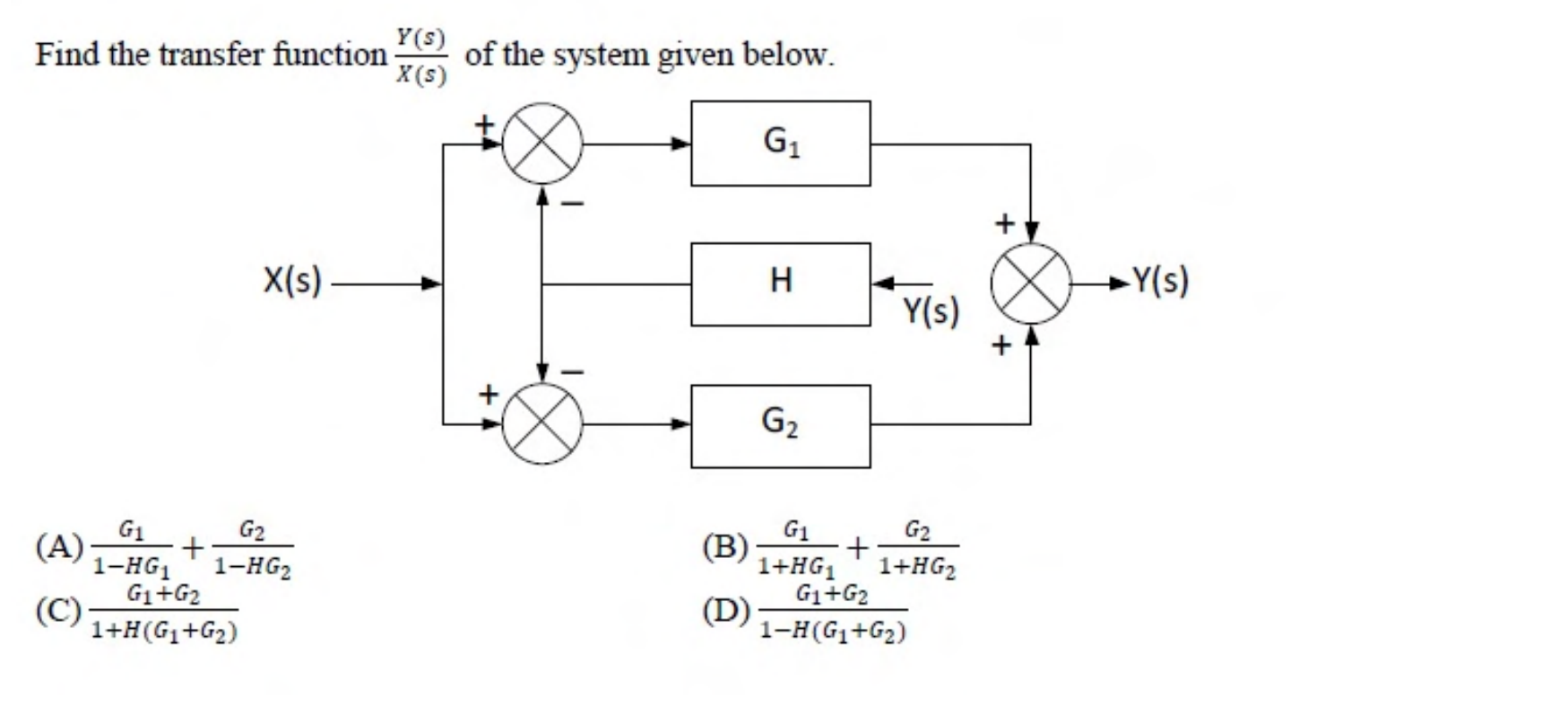
Both paths take the same signal $X - HY$, so $Y = (G_1 + G_2)(X - HY)$. Then $Y\left[1 + H(G_1 + G_2)\right] = (G_1 + G_2)X$, which gives $\frac{Y}{X} = \frac{G_1 + G_2}{1 + H(G_1 + G_2)}$.
More Mathematical modelling and representation of systems, Feedback principle, Transfer function, Block diagrams and Signal flow graphs questions
GATE 2017 EE Q42– In the system whose signal flow graph is shown in the figure, U 1(s) and U 2(s) are…
GATE 2015 EE (EE2) Q65– The system obeys x 1=2x 1+x 2+u, x 2=-2x 1+u, y=3x1. Its zero-state transfer Y(s)/U(s) is
GATE 2024 EE Q20– For the block-diagram shown in the figure, the transfer function C(s)R(s) is
GATE 2023 EE Q12– For the block diagram shown in the figure, the transfer function Y(s)R(s) is
GATE 2021 EE Q21– For the closed-loop system shown, the transfer function E(s)R(s) is
GATE 2020 EE Q23– Which of the options is an equivalent representation of the signal flow graph shown here?