GATE 2017 EC – Question 33
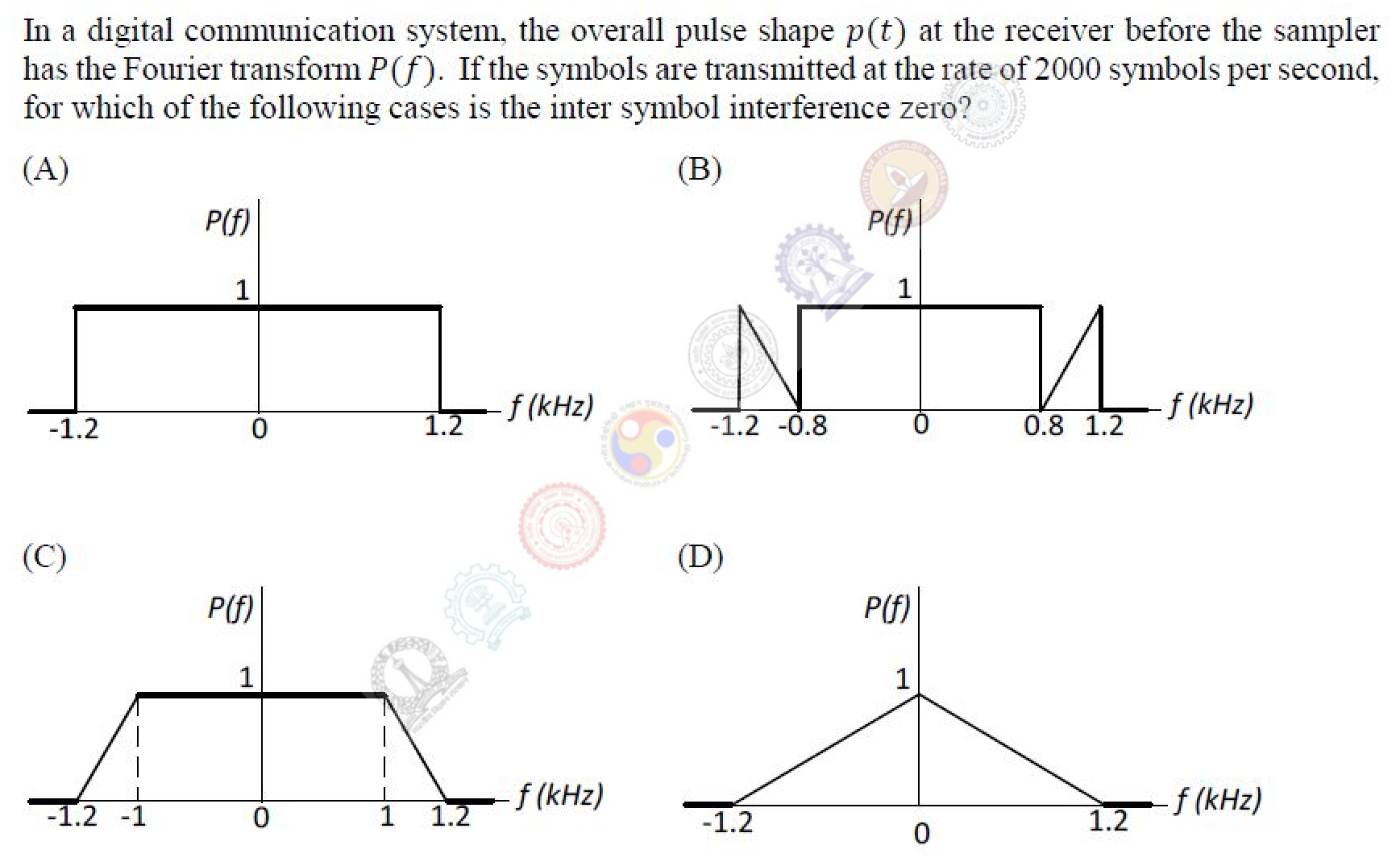
In a digital communication system, the overall pulse shape $p(t)$ at the receiver before the sampler has the Fourier transform $P(f)$. If the symbols are transmitted at the rate of 2000 symbols per second, for which of the following cases is the inter symbol interference zero?
Practise this question in The GATE Grind →
Show answer and explanation
Correct answer: (B) Plot (B)
Explanation
By the Nyquist criterion, the intersymbol interference is zero when the shifted copies $\sum_k P(f - 2000k)$ add up to a constant. In plot (B), for $f$ between 0.8 and 1.2 kHz the pulse rises linearly from 0 to 1, and the copy shifted by 2 kHz falls from 1 to 0 at the same rate, so they add up to 1. Below 0.8 kHz only one copy is present and it equals 1. So the sum is constant. In plots (A), (C) and (D) the overlapping parts add up to something other than a constant.