GATE 2017 EC – Question 47
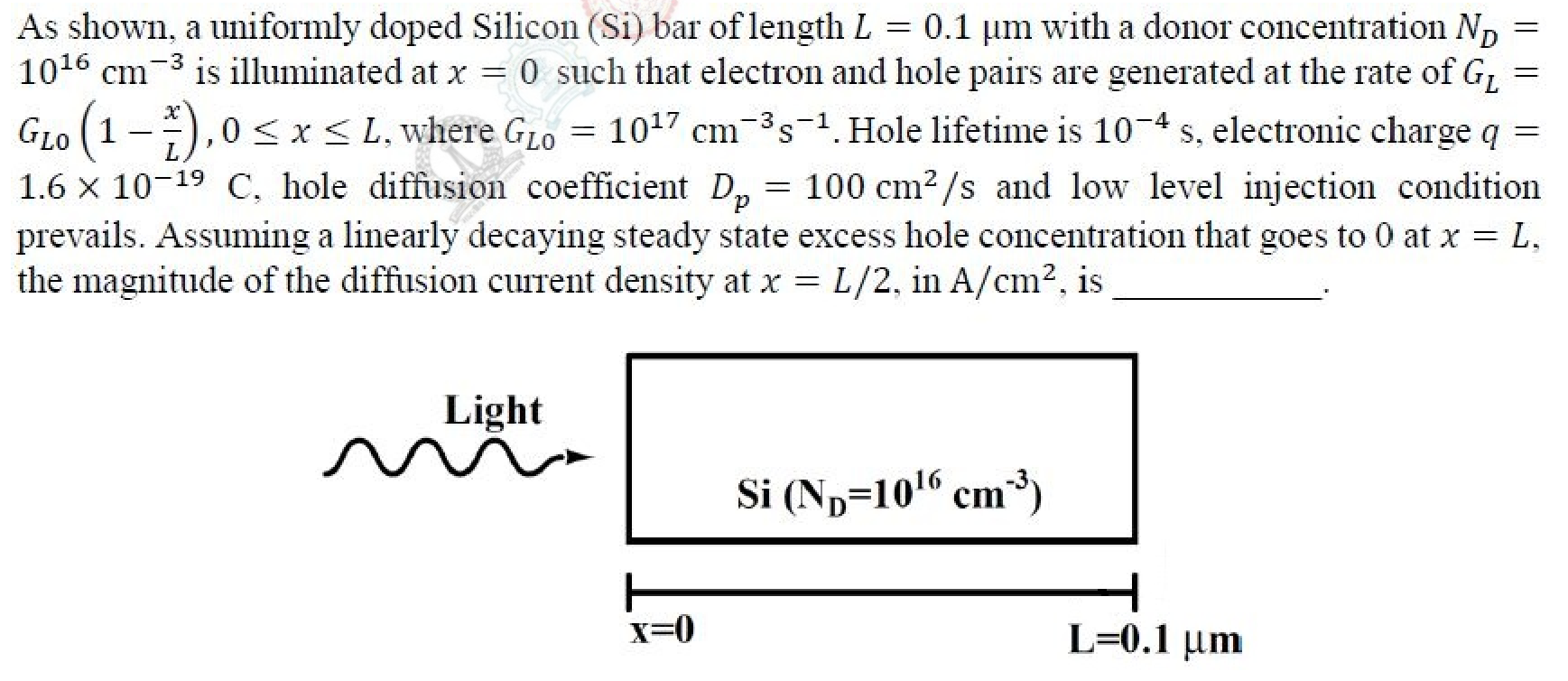
As shown, a uniformly doped Silicon (Si) bar of length $L = 0.1\ \mu$m with a donor concentration $N_D = 10^{16}$ cm$^{-3}$ is illuminated at $x = 0$ such that electron and hole pairs are generated at the rate of $G_L = G_{L0}\left(1 - \frac{x}{L}\right)$, $0 \leq x \leq L$, where $G_{L0} = 10^{17}$ cm$^{-3}$s$^{-1}$. Hole lifetime is $10^{-4}$ s, electronic charge $q = 1.6 \times 10^{-19}$ C, hole diffusion coefficient $D_p = 100$ cm$^2$/s and low level injection condition prevails. Assuming a linearly decaying steady state excess hole concentration that goes to 0 at $x = L$, the magnitude of the diffusion current density at $x = L/2$, in A/cm$^2$, is ________.
Practise this question in The GATE Grind →
Show answer and explanation
Correct answer: 16
Explanation
The excess hole concentration is linear, $\Delta p(x) = \Delta p_0\left(1 - \frac{x}{L}\right)$. Since $\Delta p$ is linear, its second derivative is zero, so in steady state the generation balances recombination and $\Delta p_0 = G_{L0}\tau = 10^{17} \times 10^{-4} = 10^{13}$ cm$^{-3}$. The diffusion current density is $J = qD_p\frac{\Delta p_0}{L} = 1.6 \times 10^{-19} \times 100 \times \frac{10^{13}}{10^{-5}\ \text{cm}} = 16$ A/cm$^2$. It is the same at every point, including $x = L/2$.