GATE 2017 EC – Question 49
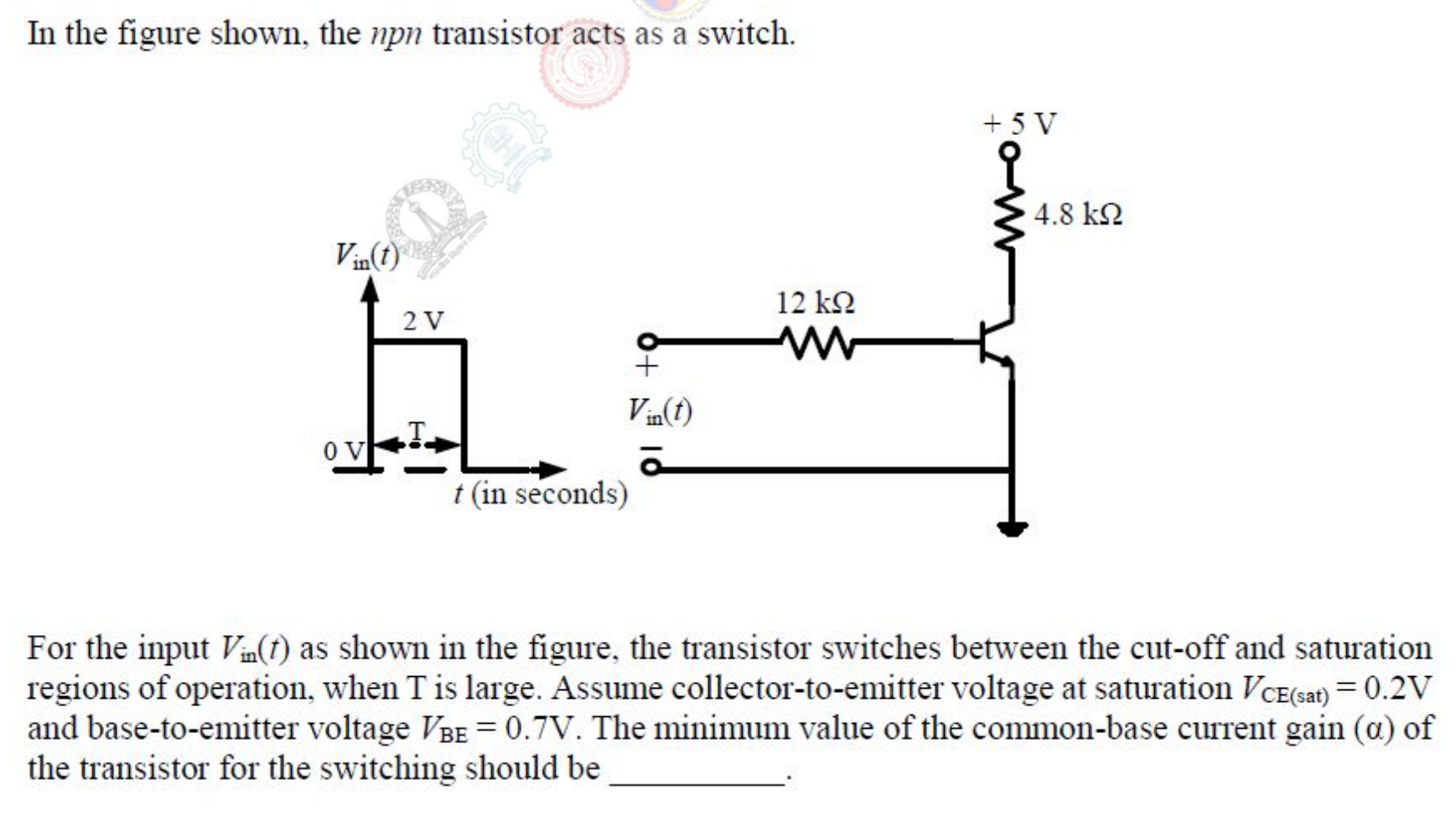
In the figure shown, the npn transistor acts as a switch.
[Figure: A $+5$ V supply feeds a $4.8\ \text{k}\Omega$ collector resistor. The base is driven by $V_{in}(t)$ through a $12\ \text{k}\Omega$ resistor. $V_{in}(t)$ is a pulse train that switches between 0 V and 2 V with width $T$.]
For the input $V_{in}(t)$ as shown in the figure, the transistor switches between the cut-off and saturation regions of operation, when $T$ is large. Assume collector-to-emitter voltage at saturation $V_{CE(sat)} = 0.2$ V and base-to-emitter voltage $V_{BE} = 0.7$ V. The minimum value of the common-base current gain ($\alpha$) of the transistor for the switching should be ________.
Practise this question in The GATE Grind →
Show answer and explanation
Correct answer: 0.89 to 0.91
Explanation
In saturation the collector current is $I_C = \frac{5 - 0.2}{4.8\ \text{k}\Omega} = 1$ mA. The base current is $I_B = \frac{2 - 0.7}{12\ \text{k}\Omega} = 0.1083$ mA. To saturate, the transistor needs $\beta \geq \frac{I_C}{I_B} = 9.23$. Then $\alpha = \frac{\beta}{1 + \beta} = \frac{9.23}{10.23} = 0.90$.