GATE 2017 EC – Question 61
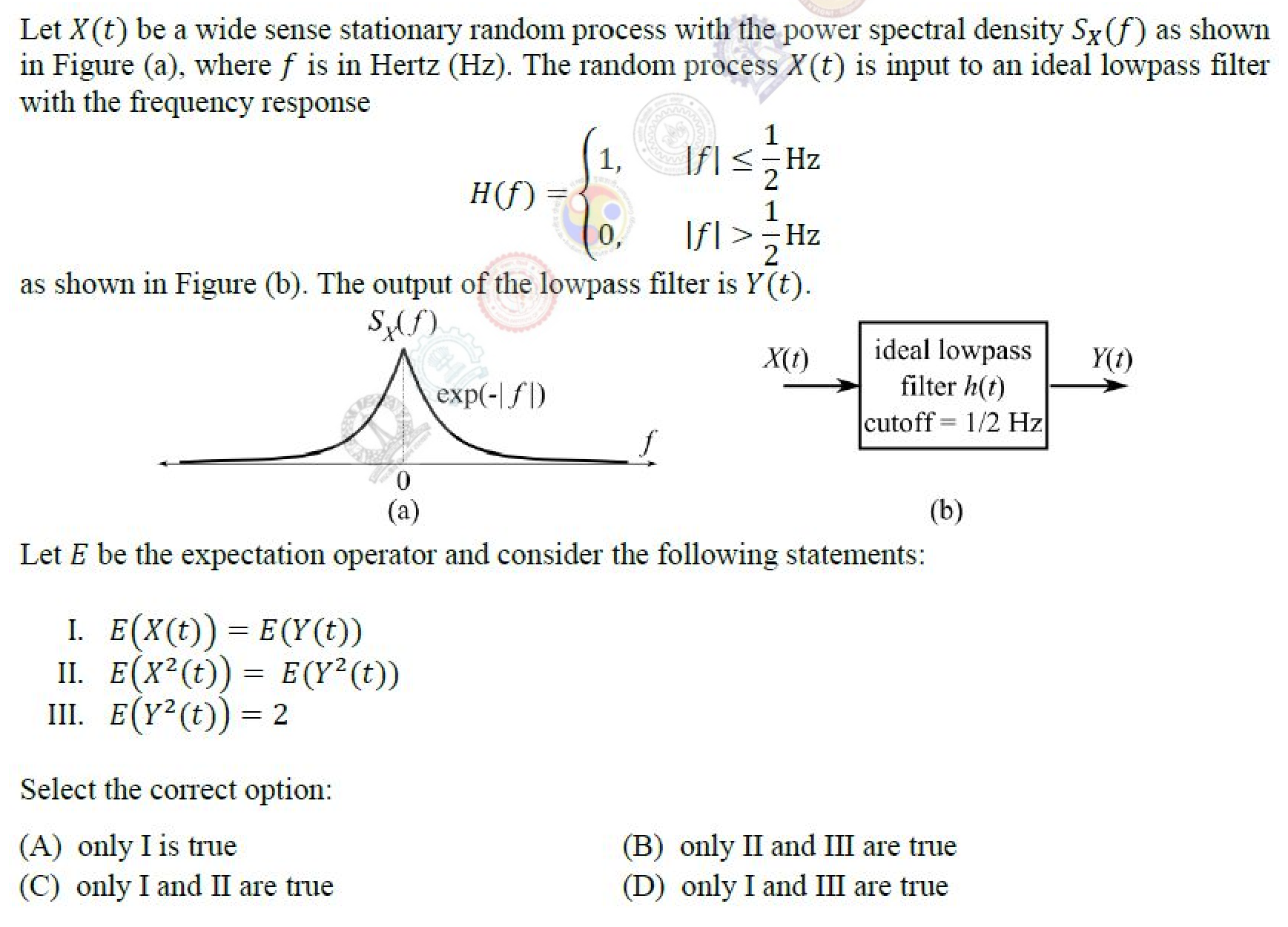
Let $X(t)$ be a wide sense stationary random process with the power spectral density $S_X(f)$ as shown in Figure (a), where $f$ is in Hertz (Hz). The random process $X(t)$ is input to an ideal lowpass filter with the frequency response
$$H(f) = \begin{cases} 1, & |f| \leq \frac{1}{2}\text{ Hz} \\ 0, & |f| > \frac{1}{2}\text{ Hz} \end{cases}$$
as shown in Figure (b). The output of the lowpass filter is $Y(t)$.
[Figure: (a) The power spectral density $S_X(f) = e^{-|f|}$, peaked at $f = 0$. (b) $X(t)$ passes through an ideal lowpass filter with cutoff $\frac{1}{2}$ Hz to give $Y(t)$.]
Let $E$ be the expectation operator and consider the following statements:
I. $E(X(t)) = E(Y(t))$
II. $E(X^2(t)) = E(Y^2(t))$
III. $E(Y^2(t)) = 2$
Select the correct option:
Practise this question in The GATE Grind →
Show answer and explanation
Correct answer: (A) only I is true
Explanation
The power spectral density has no impulse at $f = 0$, so the mean of $X$ is 0, and the filter keeps this, so $E(Y) = 0$ and I is true. The power of $X$ is $\int e^{-|f|}df = 2$. The power of $Y$ is the part within $|f| \leq \frac{1}{2}$, which is $2(1 - e^{-1/2}) = 0.787$. So $E(X^2) \neq E(Y^2)$ and $E(Y^2) \neq 2$, which makes II and III false.