GATE 2026 CE (CE2) – Question 39
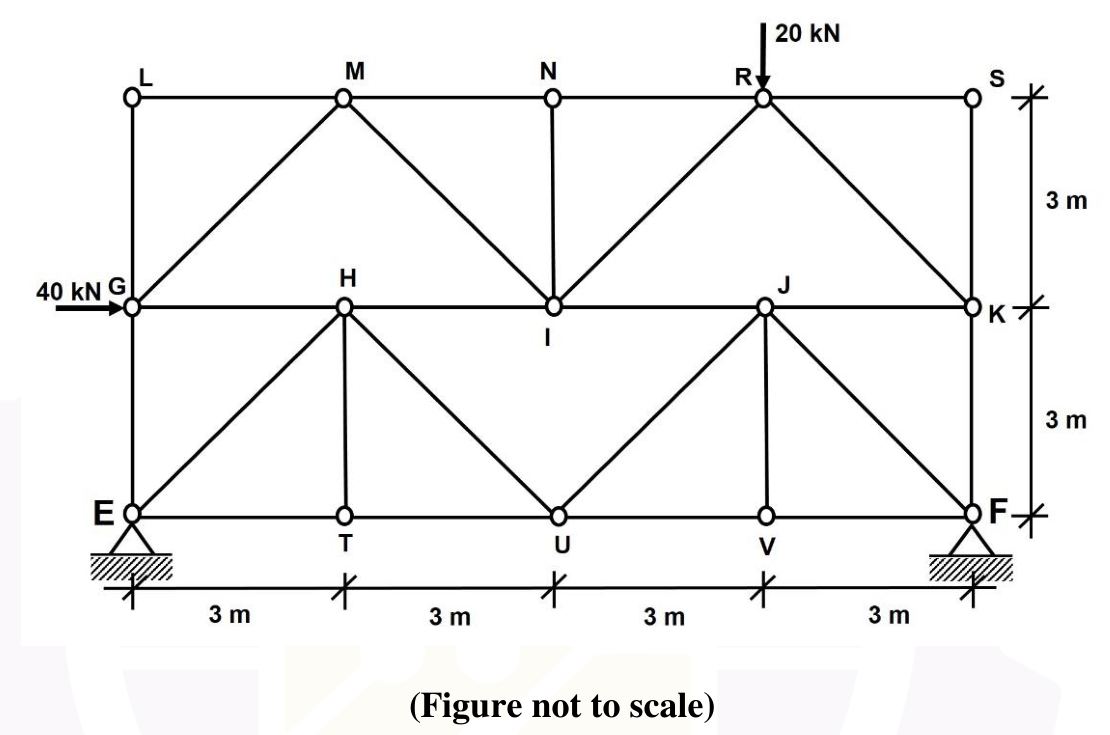
The plane truss shown in the figure is hinge-supported at E and F. The truss is subjected to vertical downward force at R and horizontal force at G.
[Figure: A plane truss 12 m long and 6 m high with joints 3 m apart. The top joints are L, M, N, R and S, the middle joints are G, H, I, J and K, and the bottom joints are E, T, U, V and F, with hinge supports at E and F. A 40 kN horizontal force acts to the right at G and a 20 kN force acts downward at R. Diagonals join G-M, M-I, I-R and R-K in the upper panel and E-H, H-U, U-J and J-F in the lower panel. The verticals are L-G, G-E, N-I, H-T, J-V, S-K and K-F. The figure is not to scale.]
The force (in kN) along with its nature in member JF is
Practise this question in The GATE Grind →
Show answer and explanation
Correct answer: (A) $10\sqrt{2}$ compression
Explanation
Joints L, N, S, T and V carry no load and meet only two non-collinear members, or a vertical member and two collinear ones, so members LM, LG, NI, RS, SK, HT and JV carry no force. Moments about E give the vertical reactions: $12F_y = 20 \times 9 + 40 \times 3$, so $F_y = 25$ kN upward and $E_y = 5$ kN downward. The two hinges can share the 40 kN horizontal reaction in many ways, but that only changes the forces in the chords and the end verticals and never the force in JF. Solving the joints, with all of the horizontal reaction taken at E, gives a force of $10\sqrt{2}$ kN in JF. At F the vertical reaction of 25 kN is shared between the vertical member KF (15 kN in compression) and the diagonal JF, whose vertical part is $\frac{10\sqrt{2}}{\sqrt{2}} = 10$ kN. The diagonal pushes on the joints, so it is in compression.