GATE 2026 CE (CE2) – Question 50
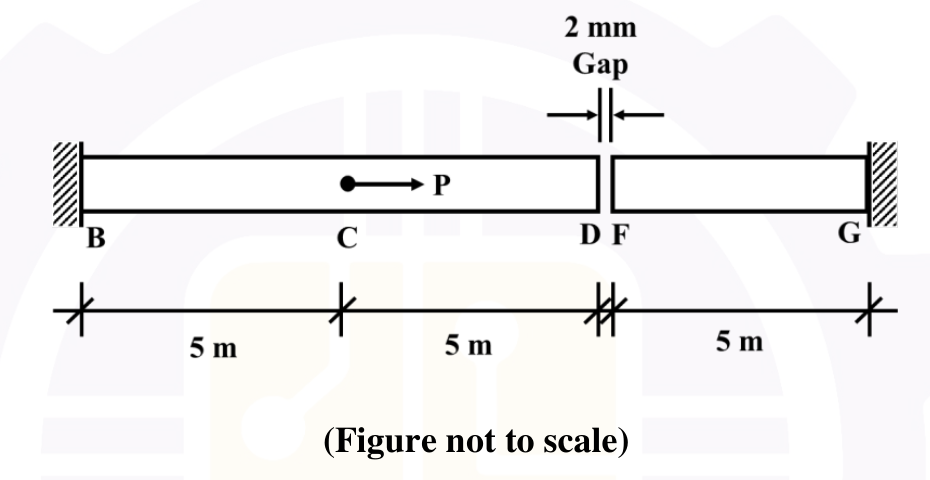
Linearly elastic, homogeneous, uniform bars BCD and FG shown in the figure have fixed supports at B and G, respectively. For both the bars, axial rigidity is 20000 kN. A gap of 2 mm exists between D and F prior to application of any load (i.e. $P = 0$). Small deformation and infinitesimal strain assumptions are valid for the given bars.
[Figure: Two collinear bars. Bar BCD is fixed at B on the left, with C at 5 m from B and D at 10 m from B. Bar FG is 5 m long and fixed at G on the right. A 2 mm gap separates D and F. A horizontal force P acts to the right at C. The figure is not to scale.]
The magnitude of the horizontal reaction (in kN) at B after application of the axial force $P$ of 20 kN at C is ______ (*rounded off to the nearest integer*).
Practise this question in The GATE Grind →
Show answer and explanation
Correct answer: 16
Explanation
Without contact, D would move $\frac{20 \times 5}{20000} = 5$ mm, which is more than the 2 mm gap, so D pushes on F. Let $R$ be the contact force between D and F. Then the reaction at B is $20 - R$. Bar BC stretches under $20 - R$ and bar CD shortens under $R$, so D moves $\frac{5(20 - R) - 5R}{20000}$ m. Bar FG shortens by $\frac{5R}{20000}$ m. The gap closes when $\frac{5(20 - 2R)}{20000} - \frac{5R}{20000} = 0.002$, so $20 - 3R = 8$ and $R = 4$ kN. The reaction at B is $20 - 4 = 16$ kN.