GATE 2024 ME – Question 37
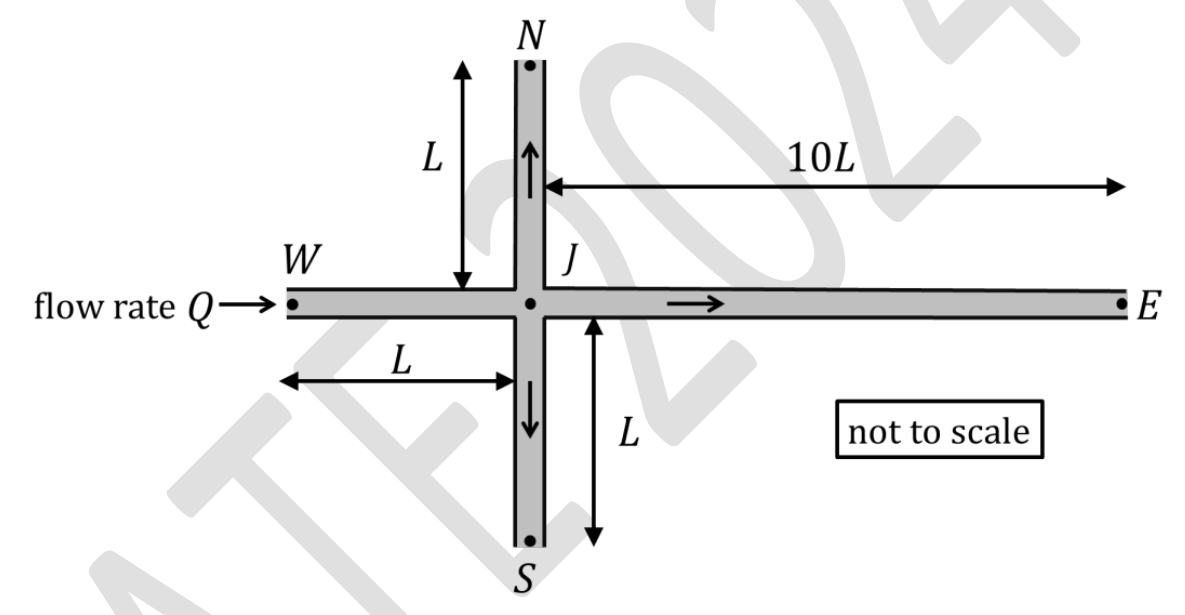
In the pipe network shown in the figure, all pipes have the same cross-section and can be assumed to have the same friction factor. The pipes connecting points $W$, $N$, and $S$ with point $J$ have an equal length $L$. The pipe connecting points $J$ and $E$ has a length $10L$. The pressures at the ends $N$, $E$, and $S$ are equal. The flow rate in the pipe connecting $W$ and $J$ is $Q$. Assume that the fluid flow is steady, incompressible, and the pressure losses at the pipe entrance and junction are negligible. Consider the following statements:
I: The flow rate in pipe connecting $J$ and $E$ is $Q/21$.
II: The pressure difference between $J$ and $N$ is equal to the pressure difference between $J$ and $E$.
Which one of the following options is CORRECT?
Practise this question in The GATE Grind →
Show answer and explanation
Correct answer: (B) I is False and II is True
Explanation
With the same friction factor and diameter, the head loss in a pipe is proportional to $L\,q^2$. The ends N, E and S are at the same pressure, so the pressure drop from J is the same in each branch, which makes statement II true. For the flows, $L q_N^2 = 10L\,q_E^2$ gives $q_N = q_S = \sqrt{10}\,q_E$, and $Q = 2q_N + q_E = (2\sqrt{10} + 1)q_E$. So $q_E = \frac{Q}{7.32}$, not $\frac{Q}{21}$ (that value would hold for laminar flow, where the loss is proportional to $Lq$), so statement I is false.