GATE 2024 ME – Question 55
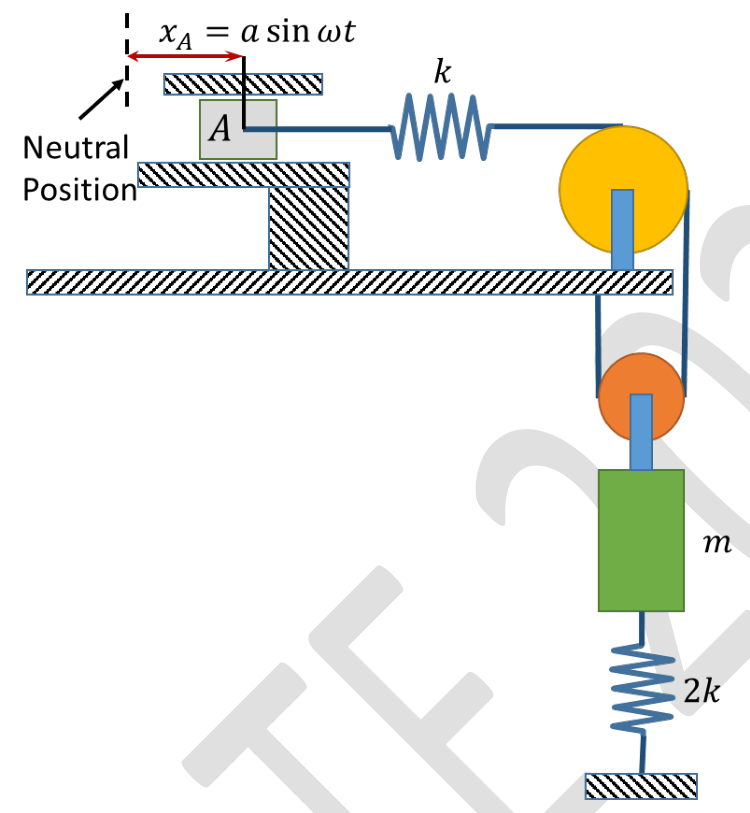
A vibratory system consists of mass $m$, a vertical spring of stiffness $2k$ and a horizontal spring of stiffness $k$. The end A of the horizontal spring is given a horizontal motion $x_A = a\sin\omega t$. The other end of the spring is connected to an inextensible rope that passes over two massless pulleys as shown. Assume $m = 10$ kg, $k = 1.5$ kN/m, and neglect friction. The magnitude of critical driving frequency for which the oscillations of mass $m$ tend to become excessively large is _________ rad/s (*answer in integer*).
Practise this question in The GATE Grind →
Show answer and explanation
Correct answer: 30
Explanation
The mass hangs from a movable pulley with the rope fixed at one end, so when the mass moves down by $x$ the end of the rope at the spring moves by $2x$. The spring $k$ is stretched by $2x - x_A$ and its tension $T = k(2x - x_A)$ pulls on the mass through two rope parts, giving a force $2T$. The equation of motion is $m\ddot{x} = -2kx - 2k(2x - x_A)$, that is $m\ddot{x} + 6kx = 2kx_A$. The natural frequency is $\omega_n = \sqrt{\frac{6k}{m}} = \sqrt{\frac{6 \times 1500}{10}} = 30$ rad/s, and the oscillations become excessively large when the driving frequency is equal to it.