GATE 2024 DA – Question 42
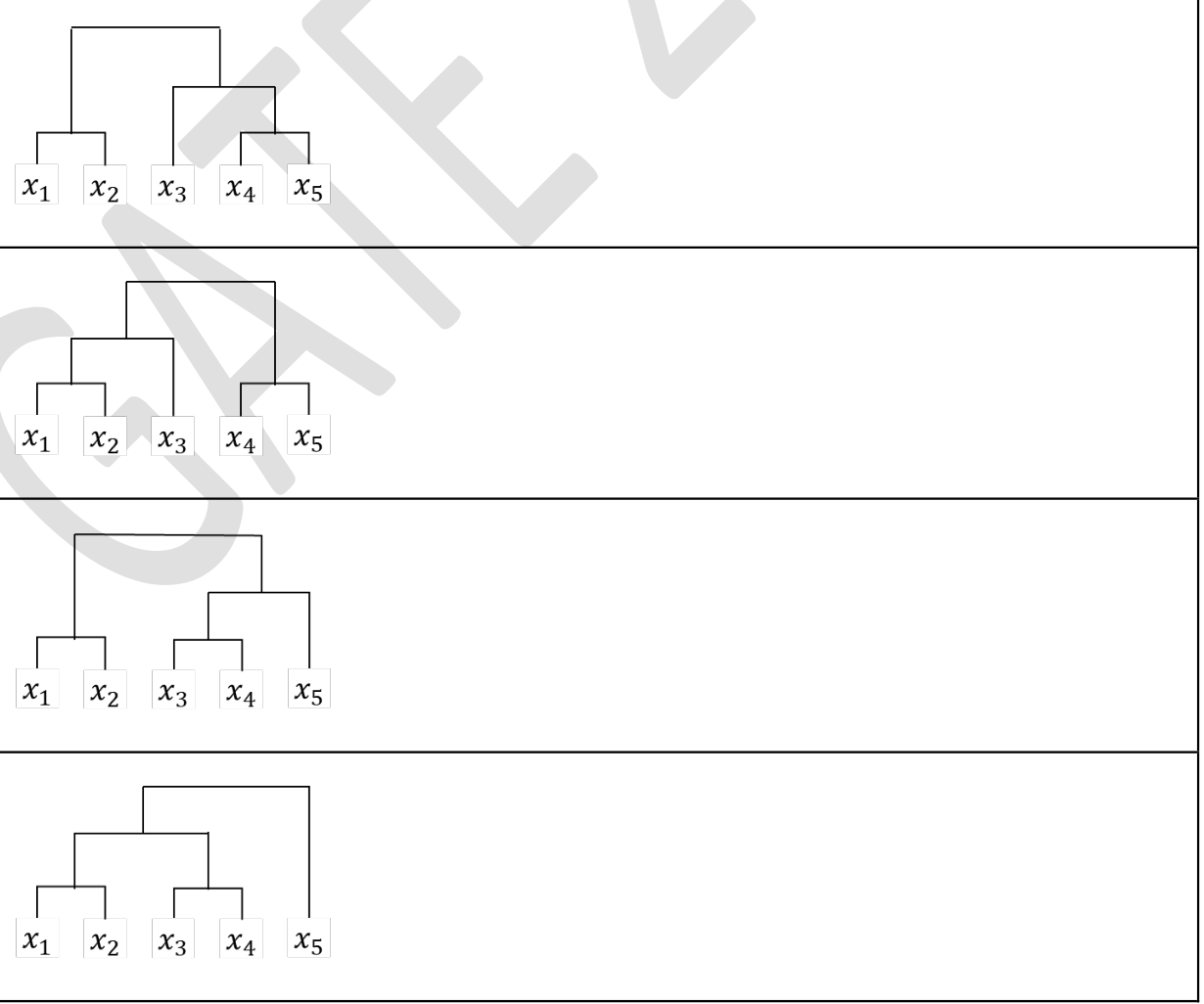
Consider the table below, where the $(i, j)^{th}$ element of the table is the distance between points $x_i$ and $x_j$. Single linkage clustering is performed on data points $x_1, x_2, x_3, x_4, x_5$.
| $x_1$ | $x_2$ | $x_3$ | $x_4$ | $x_5$ | |
|---|---|---|---|---|---|
| $x_1$ | 0 | 1 | 4 | 3 | 6 |
| $x_2$ | 1 | 0 | 3 | 5 | 3 |
| $x_3$ | 4 | 3 | 0 | 2 | 5 |
| $x_4$ | 3 | 5 | 2 | 0 | 1 |
| $x_5$ | 6 | 3 | 5 | 1 | 0 |
Which ONE of the following is the correct representation of the clusters produced?
Practise this question in The GATE Grind →
Show answer and explanation
Correct answer: (A) Option A in the figure
Explanation
In single linkage the distance between clusters is the smallest distance between their points. The smallest distance is 1, between $x_1$ and $x_2$ and also between $x_4$ and $x_5$, so these two pairs merge first. Next, the distance from $x_3$ to $\{x_4, x_5\}$ is $\min(2, 5) = 2$, and to $\{x_1, x_2\}$ is $\min(4, 3) = 3$, so $x_3$ joins $\{x_4, x_5\}$ at height 2. Finally $\{x_1, x_2\}$ and $\{x_3, x_4, x_5\}$ join at height $\min(3, 3, 5, 6, 4, 3) = 3$. Dendrogram A shows this order.