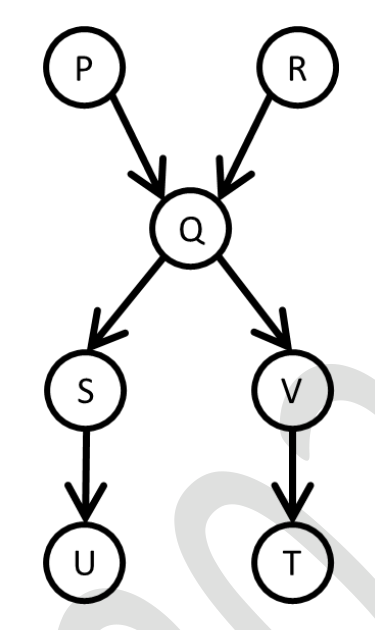
Correct answer: (B) P R Q V S U T; (D) P R Q S V T U
Explanation
In a topological order, every vertex must come after all vertices with an edge into it: Q after P and R, S and V after Q, U after S and T after V. In A and C, Q comes before R, which breaks the edge R → Q. In B (P R Q V S U T) and D (P R Q S V T U) all the conditions hold.
More Graph theory and basic graph algorithms questions
GATE 2026 DA Q40– Consider a directed graph G = (V, E), where V is the finite set of vertices and E is the…
GATE 2025 DA Q58– Let G be a simple, unweighted, and undirected graph. A subset of the vertices and edges of…
GATE 2025 DA Q65– Consider a directed graph G = (V, E), where V = \0, 1, 2, , 100\ and E = \(i, j) : 0 < j -…
GATE 2024 DA Q14– Consider performing depth-first search (DFS) on an undirected and unweighted graph G…