GATE 2023 ME – Question 31
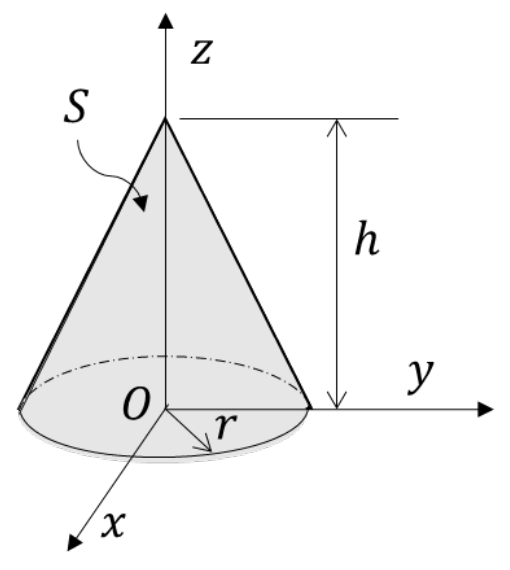
A vector field $\mathbf{B}(x, y, z) = x\hat{i} + y\hat{j} - 2z\hat{k}$ is defined over a conical region having height $h = 2$, base radius $r = 3$ and axis along $z$, as shown in the figure. The base of the cone lies in the x-y plane and is centered at the origin.
If $\mathbf{n}$ denotes the unit outward normal to the curved surface $S$ of the cone, the value of the integral $\int_S \mathbf{B} \cdot \mathbf{n}\,dS$ equals _________.
(Answer in integer)
Practise this question in The GATE Grind →
Show answer and explanation
Correct answer: 0
Explanation
The divergence of the field is $\nabla \cdot \mathbf{B} = 1 + 1 - 2 = 0$. By the divergence theorem the flux through the closed surface (the curved surface plus the base) is $\int \nabla \cdot \mathbf{B}\,dV = 0$. On the base, $z = 0$ and the outward normal is $-\hat{k}$, so $\mathbf{B} \cdot \mathbf{n} = 2z = 0$, and the base contributes nothing. So the flux through the curved surface is $0 - 0 = 0$.