GATE 2023 ME – Question 40
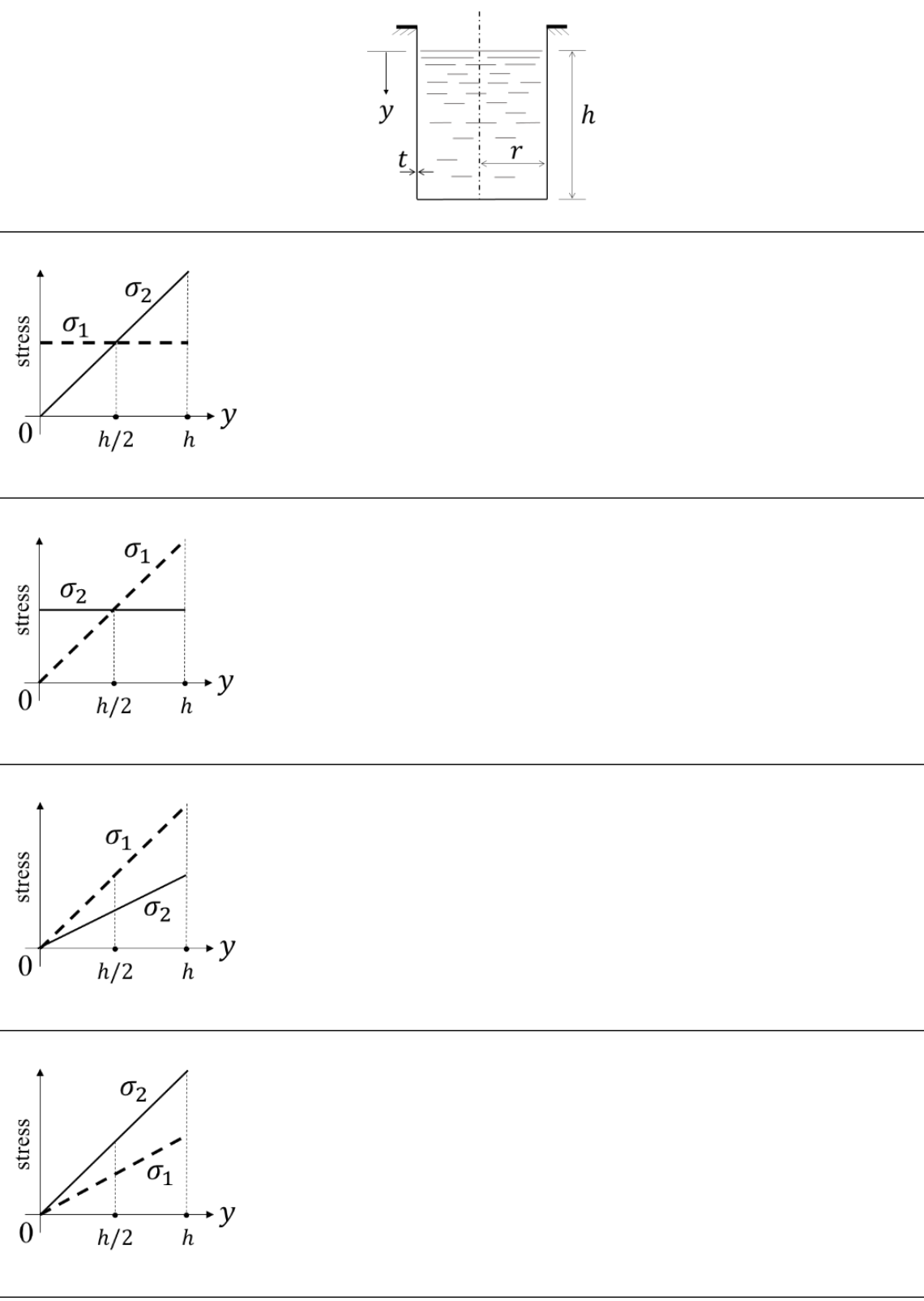
The figure shows a thin-walled open-top cylindrical vessel of radius $r$ and wall thickness $t$. The vessel is held along the brim and contains a constant-density liquid to height $h$ from the base. Neglect atmospheric pressure, the weight of the vessel and bending stresses in the vessel walls.
Which one of the plots depicts qualitatively CORRECT dependence of the magnitudes of axial wall stress ($\sigma_1$) and circumferential wall stress ($\sigma_2$) on $y$?
Practise this question in The GATE Grind →
Show answer and explanation
Correct answer: (A) Option A in the figure
Explanation
The circumferential (hoop) stress follows the liquid pressure, $p = \rho gy$, so $\sigma_2 = \frac{pr}{t} = \frac{\rho gyr}{t}$, which rises linearly from 0 at the brim to its largest value at the base. For the axial stress, cut the vessel at depth $y$ and take everything below the cut (the wall below it, the base and the liquid inside). The downward forces are the weight of the liquid below the cut, $\rho g\pi r^2(h - y)$, plus the force of the liquid above on the cut surface of the liquid, $\rho gy \times \pi r^2$. They add up to the total weight $\rho g\pi r^2h$, whatever $y$ is. This is carried by the wall of area $2\pi rt$, so $\sigma_1 = \frac{\rho gr h}{2t}$ is constant. The two stresses are equal at $y = h/2$, which is the picture in A.