GATE 2023 ME – Question 42
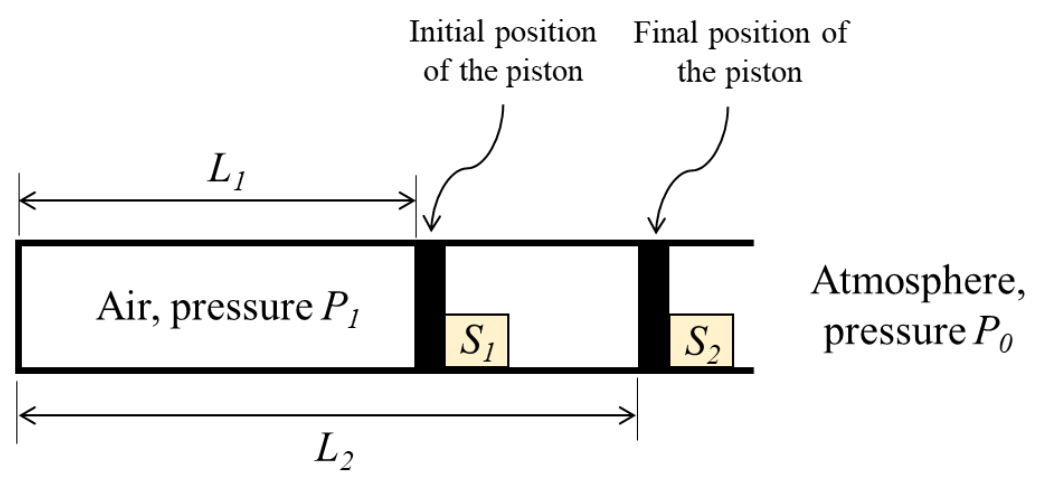
Consider a fully adiabatic piston-cylinder arrangement as shown in the figure. The piston is massless and cross-sectional area of the cylinder is $A$. The fluid inside the cylinder is air (considered as a perfect gas), with $\gamma$ being the ratio of the specific heat at constant pressure to the specific heat at constant volume for air. The piston is initially located at a position $L_1$. The initial pressure of the air inside the cylinder is $P_1 \gg P_0$, where $P_0$ is the atmospheric pressure. The stop S1 is instantaneously removed and the piston moves to the position $L_2$, where the equilibrium pressure of air inside the cylinder is $P_2 \gg P_0$.
What is the work done by the piston on the atmosphere during this process?
Practise this question in The GATE Grind →
Show answer and explanation
Correct answer: (B) $P_0A(L_2 - L_1)$
Explanation
The piston pushes against the atmosphere, which stays at the constant pressure $P_0$. The work done on the atmosphere is the atmospheric pressure times the volume swept, $P_0A(L_2 - L_1)$. The gas does more work than this, because the process is rapid (an unrestrained expansion) and the rest goes into the kinetic energy of the piston and then into the stop, but the work done on the atmosphere itself is $P_0\Delta V$.