GATE 2023 ME – Question 53
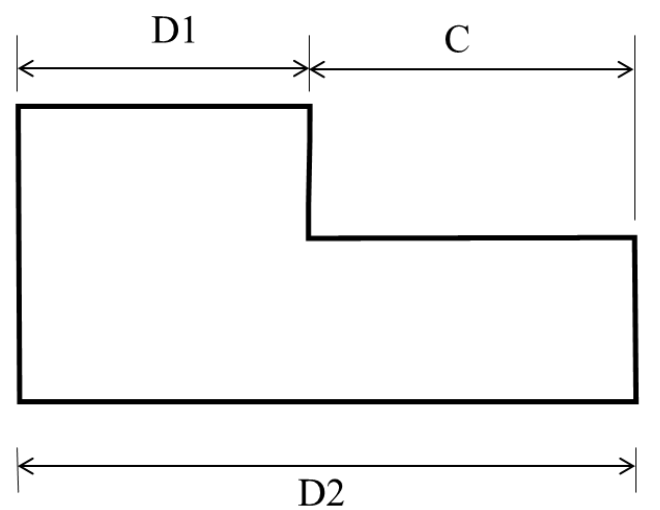
A part, produced in high volumes, is dimensioned as shown. The machining process making this part is known to be statistically in control based on sampling data. The sampling data shows that D1 follows a normal distribution with a mean of 20 mm and a standard deviation of 0.3 mm, while D2 follows a normal distribution with a mean of 35 mm and a standard deviation of 0.4 mm. An inspection of dimension C is carried out in a sufficiently large number of parts.
To be considered under six-sigma process control, the upper limit of dimension C should be ____________ mm. (Rounded off to one decimal place)
Practise this question in The GATE Grind →
Show answer and explanation
Correct answer: 17.91 to 18.09
Explanation
From the drawing, $C = D_2 - D_1$. The mean of $C$ is $35 - 20 = 15$ mm. D1 and D2 vary independently, so the variances add: $\sigma_C^2 = 0.3^2 + 0.4^2 = 0.25$ and $\sigma_C = 0.5$ mm. A six-sigma process has its specification limits $6\sigma$ from the mean, so the upper limit is $15 + 6 \times 0.5 = 18.0$ mm.