GATE 2024 CE (CE1) – Question 50
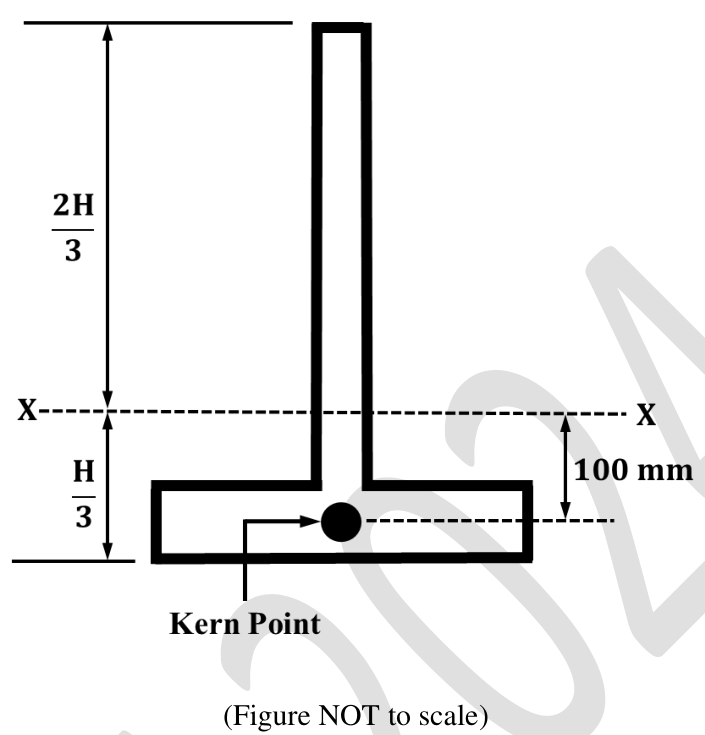
An inverted T-shaped concrete beam (B1) in the figure, with centroidal axis X − X, is subjected to an effective prestressing force of 1000 kN acting at the bottom kern point of the beam cross-section. Also consider an identical concrete beam (B2) with the same grade of concrete but without any prestressing force.
[Figure: an inverted T-section whose centroidal axis X-X is at 2H/3 from the top and H/3 from the bottom. The prestressing force acts at the bottom kern point, which is 100 mm below the axis X-X.]
The additional cracking moment (in kN.m) that can be carried by beam B1 in comparison to beam B2 is ____________ (rounded off to the nearest integer).
Practise this question in The GATE Grind →
Show answer and explanation
Correct answer: 300
Explanation
The prestress $P$ acts at the eccentricity $e = 100$ mm below the centroid (the bottom kern point). It produces the compressive stress at the bottom fibre $\frac{P}{A} + \frac{Pe}{Z_b}$, and the extra moment the beam can carry before the bottom fibre cracks is $\Delta M = Z_b\left(\frac{P}{A} + \frac{Pe}{Z_b}\right) = P\left(\frac{Z_b}{A} + e\right)$. The bottom kern distance is $k_b = \frac{Z_t}{A} = 100$ mm. Since $Z = \frac{I}{y}$ and $y_t = \frac{2H}{3}$, $y_b = \frac{H}{3}$, we have $\frac{Z_b}{Z_t} = \frac{y_t}{y_b} = 2$, so $\frac{Z_b}{A} = 200$ mm. Therefore $\Delta M = 1000 \times (0.2 + 0.1) = 300$ kN m.