GATE 2023 CE (CE1) – Question 26
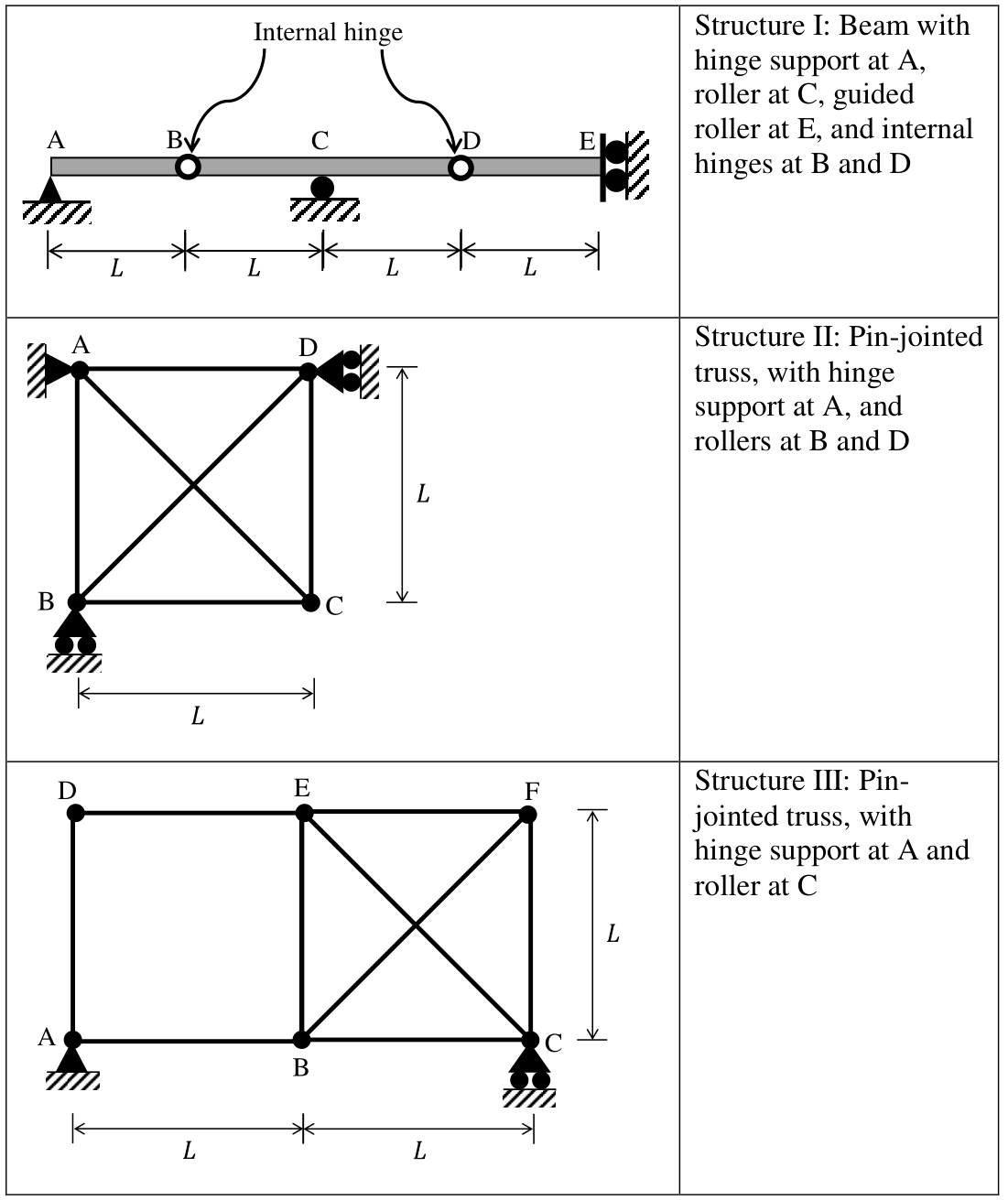
Consider the following three structures:
[Figure: Structure I is a beam A-B-C-D-E with four equal spans $L$. A is a hinge support, C is a roller, E is a guided roller on a wall, and there are internal hinges at B and D. Structure II is a square pin-jointed truss ABCD with both diagonals and side $L$. A is a hinge support at the top left, B is a roller support (vertical reaction) at the bottom left and D is a roller support (horizontal reaction) at the top right. Structure III is a pin-jointed truss with joints A, B, C on the bottom row and D, E, F on the top row (two panels of length $L$ and height $L$). The left panel ABED has no diagonal and the right panel BCFE has both diagonals. A is a hinge support and C is a roller support.]
Which of the following statements is/are TRUE?
Practise this question in The GATE Grind →
Show answer and explanation
Correct answer: (A) Structure I is unstable; (B) Structure II is unstable; (C) Structure III is unstable
Explanation
Structure I: a beam with two internal hinges has 2 extra equations for $r = 2 + 1 + 2 = 5$ reactions, so it is determinate if stable. Each hinge makes the beam segment between B and D carry no vertical force from the segments AB and DE (each of these has a hinge at both ends or is free to slide vertically at the guided roller), so the middle segment BD, resting only on the roller at C, can rotate about C. It is unstable. Structure II: the rigid square is hinged at A, with B only restrained vertically and D only horizontally. A rotation about A moves B horizontally and D vertically, and both are free, so the truss can rotate as a rigid body: unstable. Structure III: the left panel has no diagonal and the support conditions do not stop a mechanism (checked with the stiffness matrix, which is singular: rank 8 for 9 free degrees of freedom). So structures I, II and III are all unstable.