GATE 2024 CH – Question 36
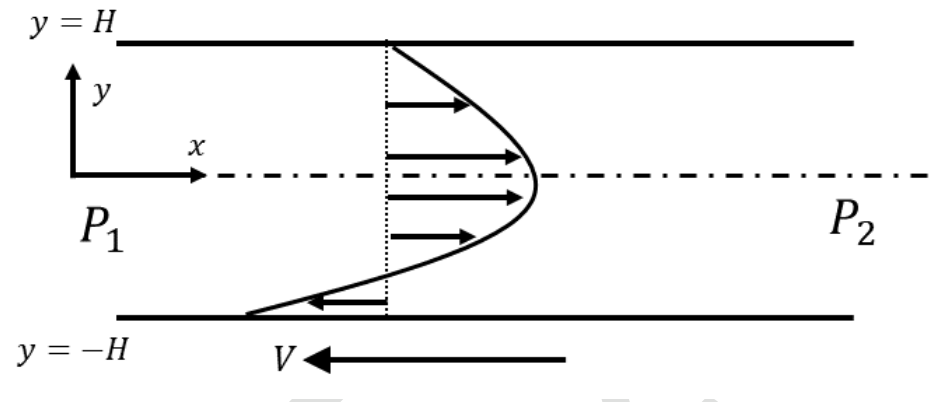
Consider a steady, fully-developed, uni-directional laminar flow of an incompressible Newtonian fluid (viscosity $\mu$) between two infinitely long horizontal plates separated by a distance $2H$ as shown in the figure. The flow is driven by the combined action of a pressure gradient and the motion of the bottom plate at $y = -H$ in the negative $x$ direction. Given that $\frac{\Delta P}{L} = \frac{(P_1 - P_2)}{L} > 0$, where $P_1$ and $P_2$ are the pressures at two $x$ locations separated by a distance $L$. The bottom plate has a velocity of magnitude $V$ with respect to the stationary top plate at $y = H$. Which one of the following represents the $x$-component of the fluid velocity vector?
Practise this question in The GATE Grind →
Show answer and explanation
Correct answer: (A) $\frac{\Delta P}{L}\frac{H^2}{2\mu}\left(1 - \frac{y^2}{H^2}\right) + \frac{V}{2}\left(\frac{y}{H} - 1\right)$
Explanation
The solution is the sum of a pressure-driven (Poiseuille) part and a plate-driven (Couette) part. Since $P_1 > P_2$ the fluid is pushed in the $+x$ direction, giving the positive parabola $\frac{\Delta P}{L}\frac{H^2}{2\mu}\left(1 - \frac{y^2}{H^2}\right)$, which vanishes at both plates. The Couette part is linear, equal to 0 at $y = H$ (the top plate at rest) and to $-V$ at $y = -H$ (the bottom plate moving in the negative direction): $\frac{V}{2}\left(\frac{y}{H} - 1\right)$. This is option A.