GATE 2023 CH – Question 55
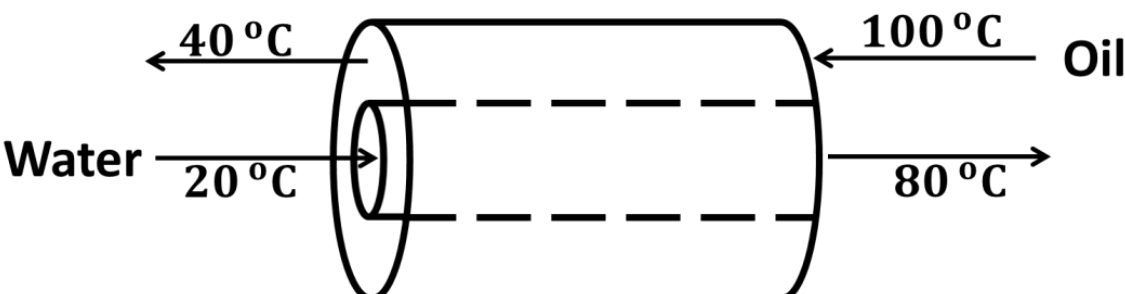
A perfectly insulated, concentric tube countercurrent heat exchanger is used to cool lubricating oil using water as a coolant (see figure below). Oil enters the outer annulus at a mass flow rate of 2 kg s$^{-1}$ with a temperature of 100 °C and leaves at 40 °C. Water enters the inner tube at a mass flow rate of 1 kg s$^{-1}$ with a temperature of 20 °C and leaves at 80 °C. Use specific heats of oil and water as 2089 J kg$^{-1}$K$^{-1}$ and 4178 J kg$^{-1}$K$^{-1}$, respectively. There is no phase change in both the streams. Under steady-state conditions, the number of transfer units (NTU) is _______ (in integer).
Practise this question in The GATE Grind →
Show answer and explanation
Correct answer: 3
Explanation
The heat capacity rates are $C_{oil} = 2 \times 2089 = 4178$ W/K and $C_{water} = 1 \times 4178 = 4178$ W/K, so they are equal: $C_r = 1$. The duty is $4178 \times 60 = 250.7$ kW and the maximum possible is $4178 \times (100 - 20) = 334.2$ kW, so the effectiveness is $\varepsilon = 0.75$. For a counter-current exchanger with $C_r = 1$, $NTU = \frac{\varepsilon}{1 - \varepsilon} = \frac{0.75}{0.25} = 3$.