GATE 2022 CH – Question 37
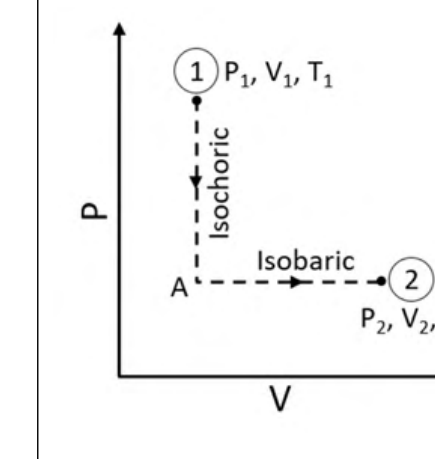
$N$ moles of an ideal gas undergo a two-step process as shown in the figure. Let $P$, $V$ and $T$ denote the pressure, volume and temperature of the gas, respectively. The gas, initially at state-1 ($P_1$, $V_1$, $T_1$), undergoes an isochoric (constant volume) process to reach state-A, and then undergoes an isobaric (constant pressure) expansion to reach state-2 ($P_2$, $V_2$, $T_2$). For an ideal gas, $C_P - C_V = NR$, where $C_P$ and $C_V$ are the heat capacities at constant pressure and constant volume, respectively, and assumed to be temperature independent. The heat gained by the gas in the two-step process is given by
Practise this question in The GATE Grind →
Show answer and explanation
Correct answer: (A) $P_2(V_2 - V_1) + C_V(T_2 - T_1)$
Explanation
By the first law, $Q = \Delta U + W$. For an ideal gas $\Delta U = C_V(T_2 - T_1)$ for any path. Work is done only in the isobaric step, at the pressure $P_A = P_2$: $W = P_2(V_2 - V_1)$. So $Q = C_V(T_2 - T_1) + P_2(V_2 - V_1)$.