GATE 2022 ME (ME1) – Question 64
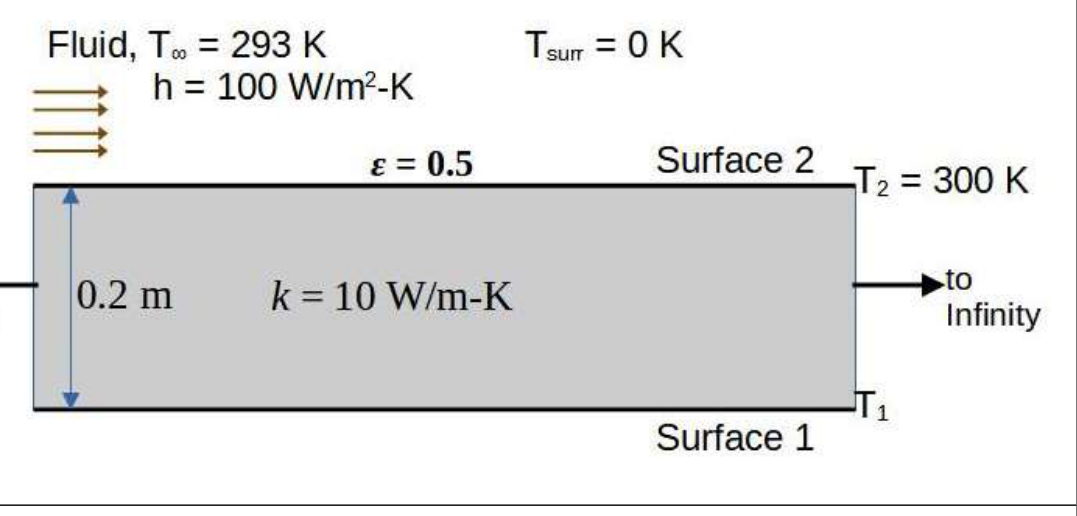
Consider a solid slab (thermal conductivity, $k = 10$ W m$^{-1}$K$^{-1}$) with thickness 0.2 m and of infinite extent in the other two directions as shown in the figure. Surface 2, at 300 K, is exposed to a fluid flow at a free stream temperature ($T_\infty$) of 293 K, with a convective heat transfer coefficient ($h$) of 100 W m$^{-2}$K$^{-1}$. Surface 2 is opaque, diffuse and gray with an emissivity ($\varepsilon$) of 0.5 and exchanges heat by radiation with very large surroundings at 0 K. Radiative heat transfer inside the solid slab is neglected. The Stefan-Boltzmann constant is $5.67 \times 10^{-8}$ W m$^{-2}$K$^{-4}$. The temperature $T_1$ of Surface 1 of the slab, under steady-state conditions, is _________ K (round off to the nearest integer).
Practise this question in The GATE Grind →
Show answer and explanation
Correct answer: 319
Explanation
In steady state the heat conducted through the slab leaves Surface 2 by convection and radiation: $\frac{k(T_1 - T_2)}{L} = h(T_2 - T_\infty) + \varepsilon\sigma T_2^4 = 100 \times 7 + 0.5 \times 5.67 \times 10^{-8} \times 300^4 = 700 + 229.6 = 929.6$ W/m². So $T_1 = 300 + \frac{929.6 \times 0.2}{10} = 318.6$ K, which is 319 K.