GATE 2025 XH5 (Psychology) – Question 4
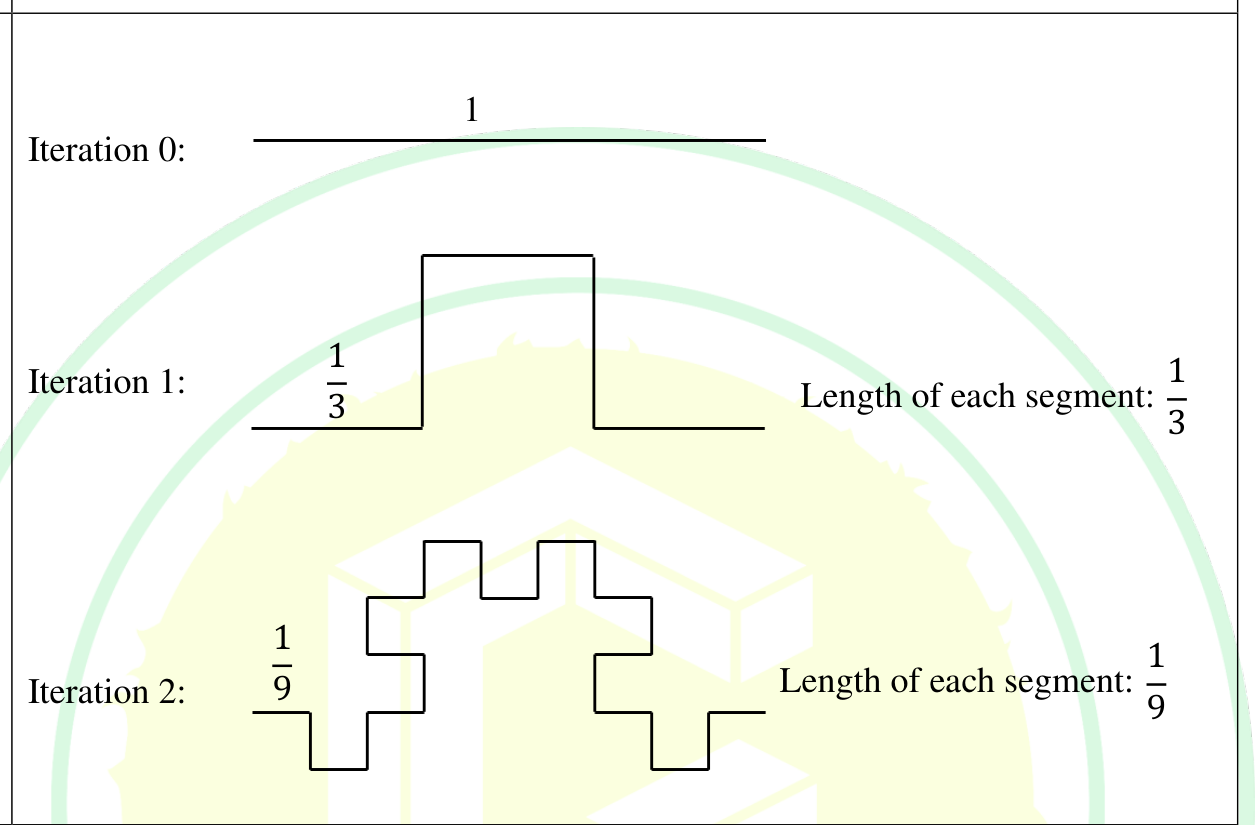
The following figures show three curves generated using an iterative algorithm. The total length of the curve generated after ‘Iteration $n$’ is:
Note: The figures shown are representative.
Practise this question in The GATE Grind →
Show answer and explanation
Correct answer: (B) $\left(\frac{5}{3}\right)^{n}$
Explanation
Each step replaces every segment by 5 segments that are one third as long. After iteration $n$ there are $5^n$ segments, each of length $\left(\frac{1}{3}\right)^n$, so the total length is $\left(\frac{5}{3}\right)^n$. This agrees with iteration 1 ($5 \times \frac{1}{3} = \frac{5}{3}$) and iteration 2 ($25 \times \frac{1}{9} = \frac{25}{9}$).