GATE 2023 CS – Question 42
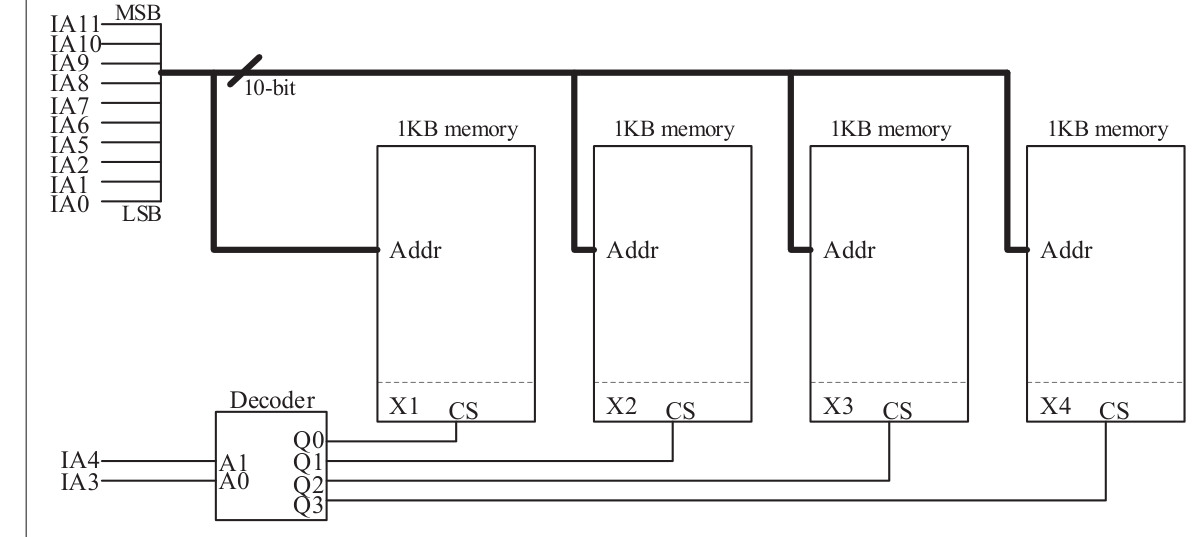
A 4 kilobyte (KB) byte-addressable memory is realized using four 1 KB memory blocks. Two input address lines (IA4 and IA3) are connected to the chip select (CS) port of these memory blocks through a decoder as shown in the figure. The remaining ten input address lines from IA11–IA0 are connected to the address port of these blocks. The chip select (CS) is active high. The input memory addresses (IA11–IA0), in decimal, for the starting locations (Addr=0) of each block (indicated as X1, X2, X3, X4 in the figure) are among the options given below. Which one of the following options is CORRECT?
Practise this question in The GATE Grind →
Show answer and explanation
Correct answer: (C) (0, 8, 16, 24)
Explanation
The 4 KB memory has 12 address lines $IA_{11}\ldots IA_0$. Each 1 KB block has a 10-bit address port, fed by $IA_{11}\ldots IA_5$ and $IA_2\ldots IA_0$ (that is, all lines except $IA_4$ and $IA_3$). The two lines $IA_4IA_3$ go to the decoder that chooses which block is enabled.
The block starts at "Addr = 0": the 10 lines to the address port are all 0. The only non-zero bits are $IA_4$ and $IA_3$:
- $X_1$: $IA_4IA_3=00\Rightarrow$ address $0$.
- $X_2$: $01\Rightarrow IA_3=1\Rightarrow2^3=8$.
- $X_3$: $10\Rightarrow IA_4=1\Rightarrow2^4=16$.
- $X_4$: $11\Rightarrow16+8=24$.
Answer $(0,8,16,24)$: option (C).