GATE 2024 AE – Question 63
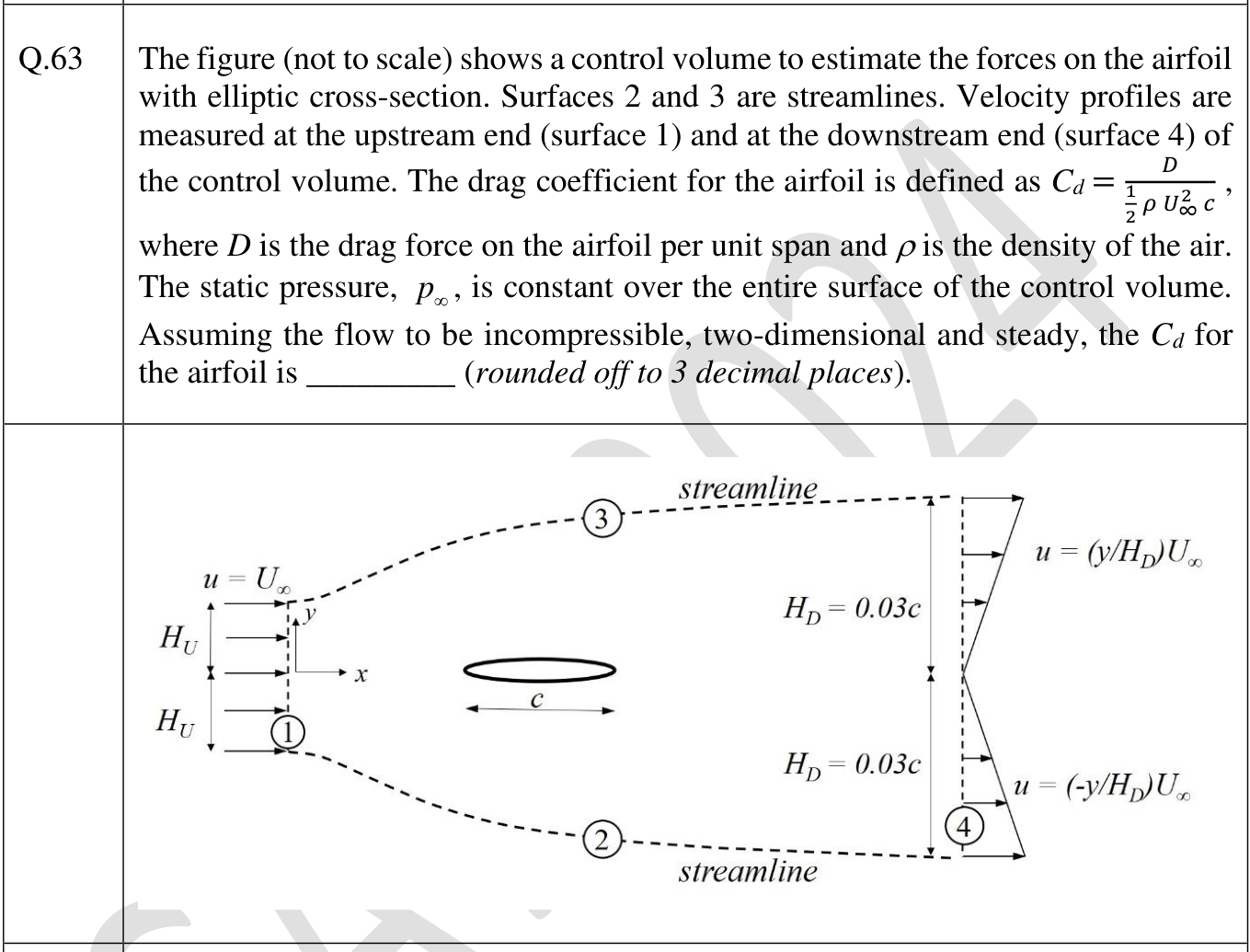
The figure (not to scale) shows a control volume to estimate the forces on the airfoil with elliptic cross-section. Surfaces 2 and 3 are streamlines. Velocity profiles are measured at the upstream end (surface 1) and at the downstream end (surface 4) of the control volume. The drag coefficient for the airfoil is defined as $C_d = \frac{D}{\frac{1}{2}\rho U_\infty^2 c}$, where D is the drag force on the airfoil per unit span and $\rho$ is the density of the air. The static pressure, $p_\infty$, is constant over the entire surface of the control volume. Assuming the flow to be incompressible, two-dimensional and steady, the $C_d$ for the airfoil is _________ (rounded off to 3 decimal places).
Practise this question in The GATE Grind →
Show answer and explanation
Correct answer: 0.010 to 0.030
Explanation
With uniform pressure on the control surface, the drag equals the momentum deficit in the wake: $D = \rho\int u(U_\infty - u)\,dy$ over the wake of half-height $H_D$ on each side (the streamlines carry no momentum flux across them, and the flow outside the wake has $u = U_\infty$). So $D = 2\rho U_\infty^2H_D\int_0^1 s(1 - s)\,ds = \frac{\rho U_\infty^2H_D}{3}$. Then $C_d = \frac{D}{\frac{1}{2}\rho U_\infty^2c} = \frac{2}{3}\frac{H_D}{c} = \frac{2}{3} \times 0.03 = 0.020$.