GATE 2022 ME (ME2) – Question 17
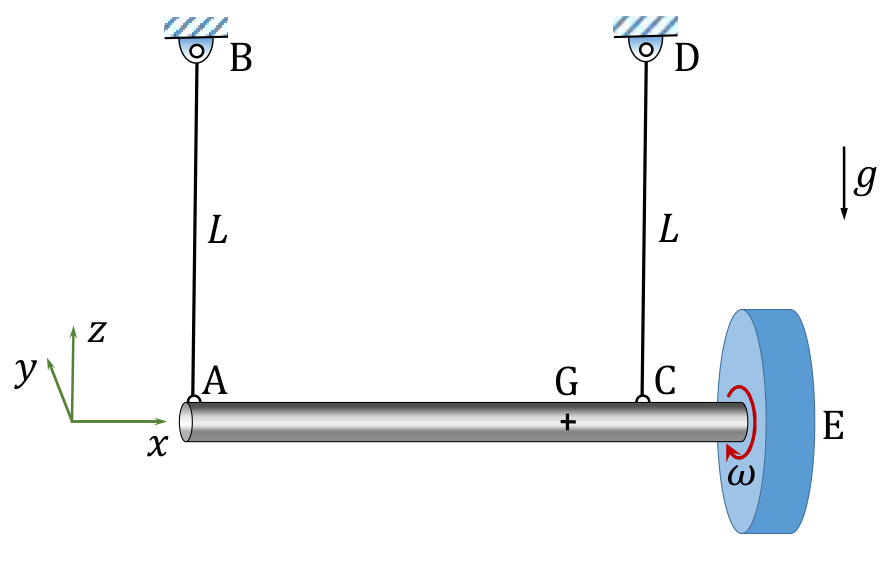
A massive uniform rigid circular disc is mounted on a frictionless bearing at the end E of a massive uniform rigid shaft AE which is suspended horizontally in a uniform gravitational field by two identical light inextensible strings AB and CD as shown, where G is the center of mass of the shaft-disc assembly and $g$ is the acceleration due to gravity. The disc is then given a rapid spin $\omega$ about its axis in the positive x-axis direction as shown, while the shaft remains at rest. The direction of rotation is defined by using the right-hand thumb rule. If the string AB is suddenly cut, assuming negligible energy dissipation, the shaft AE will
Practise this question in The GATE Grind →
Show answer and explanation
Correct answer: (A) rotate slowly (compared to the spin) about the negative z-axis direction
Explanation
This is a **gyroscopic precession** problem. The disc spins about the +x axis, so its angular momentum is $\mathbf H=H\hat i$ with $H>0$.
**Step 1: the torque after AB is cut.** The assembly now hangs only from the string at C, so the weight acting at G gives a moment about C. G lies to the left of C (the $-x$ side) and the weight acts downward ($-\hat k$), so
$$\boldsymbol\tau=\mathbf r\times\mathbf W=(-\hat i)\times(-\hat k)\,r W=-\,rW\,\hat j .$$
(using $\hat i\times\hat k=-\hat j$, so $(-\hat i)\times(-\hat k)=\hat i\times\hat k=-\hat j$).
**Step 2: precession.** For a fast spin the shaft does not fall; it precesses so that $\boldsymbol\tau=\boldsymbol\Omega\times\mathbf H$. Try $\boldsymbol\Omega=\Omega\hat k$ (a rotation about the vertical axis):
$$\hat k\times\hat i=\hat j,$$
so a negative $\boldsymbol\tau$ along $-\hat j$ needs $\Omega<0$, which means $\boldsymbol\Omega$ points along **$-\hat k$**.
The shaft therefore rotates slowly about the **negative $z$-axis** (option A), much more slowly than the spin.