GATE 2022 ME (ME2) – Question 37
A rigid homogeneous uniform block of mass 1 kg, height $h=0.4$ m and width $b=0.3$ m is pinned at one corner and placed upright in a uniform gravitational field ($g=9.81$ m/s$^2$), supported by a roller in the configuration shown in the figure. A short duration (impulsive) force F, producing an impulse $I_F$, is applied at a height of $d=0.3$ m from the bottom as shown. Assume all joints to be frictionless. The minimum value of $I_F$ required to topple the block is
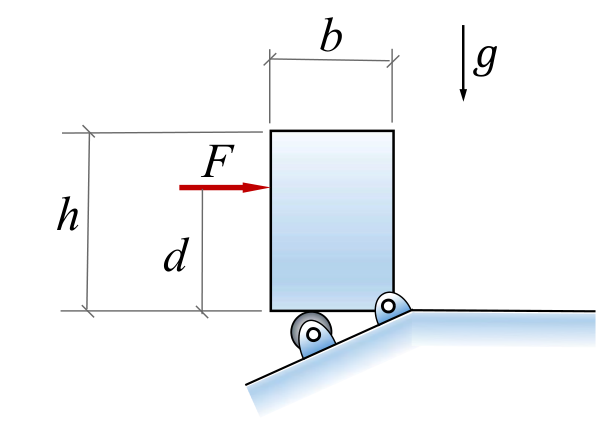
Practise this question in The GATE Grind →
Show answer and explanation
Correct answer: (A) 0.953 Ns
Explanation
**Step 1: moment of inertia about the pivot corner.** For a rectangular block of mass $m$, width $b$ and height $h$, about its centroid $I_G=\dfrac m{12}(b^2+h^2)$. About the corner, using the parallel-axis theorem with $r^2=(b/2)^2+(h/2)^2$:
$$I_O=\frac m{12}(b^2+h^2)+m\frac{b^2+h^2}{4}=\frac m3(b^2+h^2)=\frac13(0.09+0.16)=\frac1{12}\text{ kg m}^2 .$$
**Step 2: topple condition.** The impulse gives an angular velocity $\omega$ about the corner: $I_F\,d=I_O\,\omega$. To topple, the centre of mass must rise to the highest point, directly above the pivot. The centre starts at height $h/2=0.20$ m and ends at $r=\sqrt{0.15^2+0.20^2}=0.25$ m, so it rises
$$\Delta h=0.25-0.20=0.05\text{ m}.$$
**Step 3: energy.**
$$\tfrac12I_O\omega^2=mg\,\Delta h\;\Rightarrow\;\omega=\sqrt{\frac{2(1)(9.81)(0.05)}{1/12}}=3.43\text{ rad/s}.$$
**Step 4: impulse.**
$$I_F=\frac{I_O\,\omega}{d}=\frac{(1/12)(3.431)}{0.3}=\mathbf{0.953\ Ns}.$$