GATE 2022 ME (ME2) – Question 62
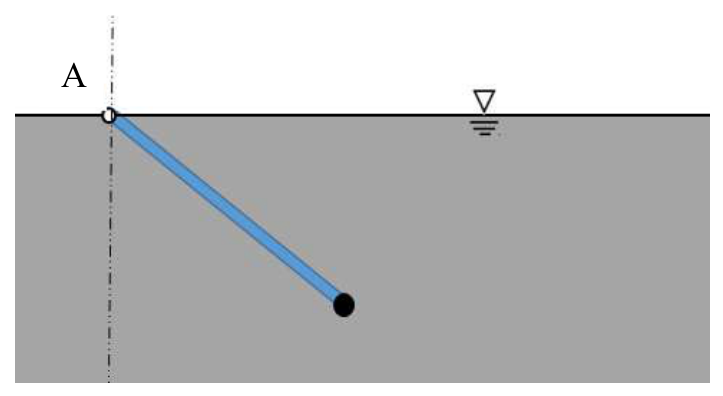
A uniform wooden rod (specific gravity = 0.6, diameter = 4 cm and length = 8 m) is immersed in the water and is hinged without friction at point A on the waterline as shown in the figure. A solid spherical ball made of lead (specific gravity = 11.4) is attached to the free end of the rod to keep the assembly in static equilibrium inside the water. For simplicity, assume that the radius of the ball is much smaller than the length of the rod. Assume density of water = $10^3$ kg/m$^3$ and π = 3.14. Radius of the ball is ______ cm (round off to 2 decimal places).
Practise this question in The GATE Grind →
Show answer and explanation
Correct answer: 3.57 to 3.61
Explanation
The rod is hinged at A on the waterline and rests inclined. Take moments about the hinge. The weight and buoyancy of each part act vertically, so each moment arm is the horizontal distance, equal to (distance along the rod) × (the same angle factor $\sin\theta$). The factor cancels from both sides.
**Step 1: the rod.** Volume $V_r=\pi\left(0.02\right)^2(8)=0.01005\text{ m}^3$. Weight $\rho_rV_rg$ acts at the centre (4 m from A) and buoyancy $\rho_wV_rg$ acts at the same point. The net **upward** force is $(1000-600)V_rg=0.4(1000)V_rg$ and acts at $L/2$.
**Step 2: the lead ball** at the free end (distance $L$). Its volume is $V_b=\dfrac43\pi r^3$. Net **downward** force: $(11.4-1)(1000)V_bg$.
**Step 3: balance of moments about A.**
$$(0.4)(1000)V_rg\,\frac L2=(10.4)(1000)V_bg\,L$$
$$V_b=\frac{0.4\,V_r}{2\times10.4}=0.01005\times\frac{0.4}{20.8}=1.933\times10^{-4}\text{ m}^3 .$$
**Step 4: radius.**
$$\frac43(3.14)r^3=1.933\times10^{-4}\;\Rightarrow\;r^3=4.617\times10^{-5}\;\Rightarrow\;r=0.03587\text{ m}.$$
The ball radius is **3.59 cm**.